
Chapter 4 – Simple Equations
Chapter Notes
Expressions
Any expression involving constant, variable and some operations like addition, multiplication etc is called Algebraic Expression.
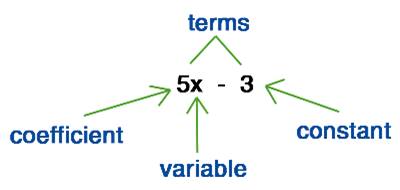
A variable is an unknown number and generally, it is represented by a letter like x, y, z, a, m etc.
Any number without any variable is called Constant.
A number followed by a variable is called Coefficient of that variable.
A term is any number or variable separated by operators.
Equation
An equation is a condition on a variable. It says that two expressions are equal.
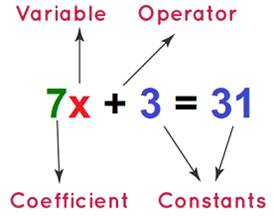
In an Equation:
(i) One of the expressions must have a variable.
(ii) LHS of the equation is equal to the RHS of the equation.
(iii) There is always an equality sign.
(iv) If we interchange the position of the expression from LHS to RHS or vice versa, the equation remains the same. E.g., both of the following equations are same.
2x − 3 = 17
17 = 2x − 3
(iv) add the same number to both the sides, or
(v) subtract the same number from both the sides, or
(vi) multiply both sides by the same non-zero number or
(vii) divide both sides by the same non-zero number.
Formation of equations from statements
1. The sum of seven times of x and 2 is equal to 51.
7x + 2 = 51
2. Nine subtracted from 2 times a number gives 31
2x – 9 = 31
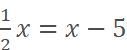
3. Half of a number is 5 less than the number itself.
Formation of an Equation from a Solution
As we solve the equation to get the solution, we can get the equation also if we have the solution.
Any equation has only one solution but if we make an equation from a solution then there could be many equations.
Example
Given x = 8
3x = 24 (multiply both sides by 3)
3x + 11 = 35 (add 11 to both the sides)
There could be other equations also, depending on the number by which both sides are multiplied/divided or the number added/subtracted on both sides.
The Solution (or Root or Zero) of an Equation
Any value of the variable which satisfies the equation is the solution of the equation.
Method 1: By adding or subtracting the same number to both the sides
Example: 1
x + 8 = 25
Solution:
Subtract 8 from both the sides.
x + 8 – 8 = 25 – 8
x = 17
Here, x = 17 is the solution/root/zero of the given equation.
Example: 2
25z = 175
Solution:
Divide both the sides by 25.
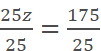
z = 7
Method 2: Transposing Method
In this method, we transpose (move) the numbers (and/or terms) from one side of the equation to the other side so that all the terms with variable come on one side and all the constants come on another side.
While transposing the numbers the sign of the terms will get changed. i.e. Negative will become positive and positive will become negative.
Example
x + 8 = 25
Solution
Now we will transfer 8 from LHS to RHS and its sign will get reversed.
x = 25 – 8
x = 17
Practice Questions
Question: Raju’s father’s age is 5 years more than three times Raju’s age. Find
Raju’s age, if his father is 44 years old.
Solution:
As given in Example 3 earlier, the equation that gives Raju's age is
3y + 5 = 44
To solve it, we first transpose 5, to get
3y = 44 – 5 = 39
Dividing both sides by 3, we get
y = 13
That is, Raju’s age is 13 years.
Question: The sum of three times a number and 11 is 32. Find the number.
Solution:
If the unknown number is taken to be x, then three times the number is 3x and the sum of 3x and 11 is 32. That is,
3x + 11 = 32
To solve this equation, we transpose 11 to RHS, so that
3x = 32 – 11
3x = 21
Now, divide both sides by 3

x = 7
The required number is 7. (We may check it by taking 3 times 7 and adding 11 to it. It gives 32 as required.)
Online Tuitions & Self-Study Courses for Grade 6 to 12 & JEE / NEET