
Algebraic Expression
A mathematical expression which consists of numbers, variables and operations is called Algebraic Expression.
Algebraic
expressions have no sides (LHS or RHS) or equal to sign ( = ) like algebraic
equations.
Examples of algebraic expressions: 5x
− 7, 9z2 + 4z
– 1.
1. Terms
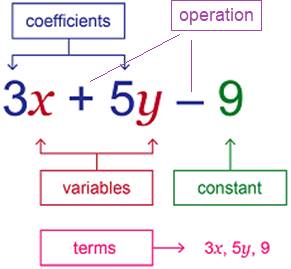
Terms are those parts of an expressions which are separated by an operation ( + or − ). E.g., 3x, 5y and 9 are the terms in the above figure.
2. Factors
Terms might be formed by the product of factors. E.g., term 3x is the product of factors 3 and x.
3. Coefficient
The number placed before the variable or the numerical factor of a term is called Coefficient of that variable. E.g., 3 is the coefficient (numerical factor) of 3x.
4. Variable
A variable can take any value. Its value is not fixed. It is represented by any letter like x, y, p, q, a, b, etc. are called Variables. The variables in the above figure are x and y.
5. Operations
Addition and subtraction are called the operations. These separate each term.
6. Constant
The term which is a number without any variable is called constant. E.g., 9 is constant in above figure.
Number Line and an Expression
An expression can be represented on the number line.
Example
How to represent x + 5 and x – 5 on the number line?
Solution:
First, mark the distance x and then x + 5 will be 5 unit to the right of x.
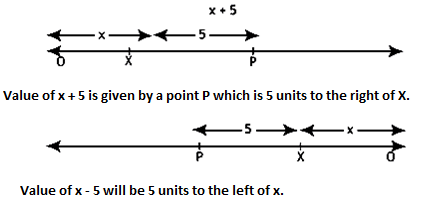
In the case of x – 5 we will start from the right and move towards the negative side. x – 5 will be 5 units to the left of x.
Monomials, Binomials and Polynomials
|
Expressions |
Meaning |
Example |
|
Monomial |
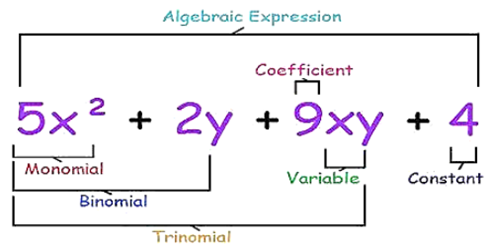
The algebraic expression having only one term. |
5x2 |
|
Binomial |
The algebraic expression having two terms. |
5x2 + 2y |
|
Trinomial |
The algebraic expression having three terms. |
5x2 + 2y + 9xy |
|
Polynomial |
The algebraic expression having one or more terms with the variable having non−negative integers as an exponent. |
5x2 + 2y + 9xy + 4 |
Binomials, trinomials, … are also polynomials.
Like and Unlike Terms
Terms having the same variable are called Like Terms.
Examples of Like Terms
2x and −9x
24xy and 5yx
6x2 and 12x2
The terms having different variable are called, Unlike Terms.
Examples of Unlike Terms
2x and − 9y
24xy and 5pq
6x2 and 12y2
Addition and Subtraction of Algebraic Expressions
Steps to add or Subtract Algebraic Expression
First of all, we have to write the algebraic expressions in different rows in such a way that the like terms come in the same column.
Add them as we add other numbers.
If any term of the same variable is not there in another expression then write is as it is in the solution.
Example
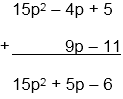
Add 15p2 – 4p + 5 and 9p – 11
Solution:
Write down the expressions in separate rows with like terms in the same column and add.
Example
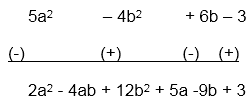
Subtract 5a2 – 4b2 + 6b – 3 from 7a2 – 4ab + 8b2 + 5a – 3b.
Solution:
For subtraction also write the expressions in different rows. But to subtract we have to change their signs from negative to positive and vice versa.
Multiplication of Algebraic Expressions
While multiplying we need to take care of some points about the multiplication of like and unlike terms.
1. Multiplication of Like Terms
The coefficients will get multiplied.
The power will not get multiplied but the resultant variable will be the addition of the individual powers.
Example
The product of 4x and 3x will be 12x2.
The product of 5x, 3x and 4x will be 60x3.
2. Multiplication of Unlike Terms
The coefficients will get multiplied.
The power will remain the same if the variable is different.
If some of the variables are the same then their powers will be added.
Example
The product of 2p and 3q will be 6pq
The product of 2x2y, 3x and 9 will be 54x3y
Multiplying a Monomial by a Monomial
1. Multiplying Two Monomials
While multiplying two polynomials the resultant variable will come by
The coefficient of product = Coefficient of the first monomial × Coefficient of the second monomial
The algebraic factor of product = Algebraic factor of the first monomial × Algebraic factor of the second monomial.
Example
25y × 3xy = 125xy2
2. Multiplying Three or More Monomials
While multiplying three or more monomial the criterion will remain the same.
Example
4xy × 5x2y2 × 6x3y3 = (4xy × 5x2y2) × 6x3y3
= 20x3y3 × 6x3y3
= 120x3y3 × x3y3
= 120 (x3 × x3) × (y3 × y3)
= 120x6 × y6
= 120x6y6
We can do it in other way also
4xy × 5x2y2 × 6x3 y3
= (4 × 5 × 6) × (x × x2 × x3) × (y × y2 × y3)
= 120 x6y6
Multiplying a Monomial by a Polynomial
1. Multiplying a Monomial by a Binomial
To multiply a monomial with a binomial we have to multiply the monomial with each term of the binomial.
Example
Multiplication of 8 and (x + y) will be (8x + 8y).
Multiplication of 3x and (4y + 7) will be (12xy + 21x).
Multiplication of 7x3 and (2x4 + y4) will be (14x7+ 7x3y4).
2. Multiplication of Monomial by a trinomial
This is also the same as above.
Example
Multiplication of 8 and (x + y + z) will be (8x + 8y + 8z).
Multiplication of 4x and (2x + y + z) will be (8x2 + 4xy + 4xz).
Multiplication of 7x3 and (2x4+ y4+ 2) will be (14x7 + 7x3y4 + 14x3).
Multiplying a Polynomial by a Polynomial
1. Multiplying a Binomial by a Binomial
We use the distributive law of multiplication in this case. Multiply each term of a binomial with every term of another binomial. After multiplying the polynomials we have to look for the like terms and combine them.
Example
Simplify (3a + 4b) × (2a + 3b)
Solution:
(3a + 4b) × (2a + 3b)
= 3a × (2a + 3b) + 4b × (2a + 3b) [distributive law]
= (3a × 2a) + (3a × 3b) + (4b × 2a) + (4b × 3b)
= 6 a2 + 9ab + 8ba + 12b2
= 6 a2 + 17ab + 12b2 [ba = ab]
2. Multiplying a Binomial by a Trinomial
In this also we have to multiply each term of the binomial with every term of trinomial.
Example
Simplify (p + q) (2p – 3q + r) – (2p – 3q) r.
Solution:
We have a binomial (p + q) and one trinomial (2p – 3q + r). First multiplying these two.
(p + q) (2p – 3q + r)
= p(2p – 3q + r) + q (2p – 3q + r)
= 2p2 – 3pq + pr + 2pq – 3q2 + qr
= 2p2 – pq – 3q2 + qr + pr (–3pq and 2pq are like terms)
Therefore,
(p + q) (2p – 3q + r) – (2p – 3q) r
= 2p2 – pq – 3q2 + qr + pr – (2pr – 3qr)
= 2p2 – pq – 3q2 + qr + pr – 2pr + 3qr
= 2p2 – pq – 3q2 + (qr + 3qr) + (pr – 2pr)
= 2p2 – 3q2 – pq + 4qr – pr
Identities
An identity is an equality which is true for every value of the variables.
An equation is not an identity, as an equation is true for only some of the values of the variables.
E.g., x2 = 1, is valid if x is 1 but is not true if x is 2. It is an equation but not an identity.
Some of the Standard Identities
(a + b)2 = a2 + 2ab + b2
(a − b)2 = a2 – 2ab + b2
a2 – b2 = (a + b) (a − b)
(x + a) (x + b) = x2 + (a + b)x + ab
(a + b + c)2 = a2 + b2 + c2 + 2ab + 2bc + 2ca
These identities are useful in carrying out squares and products of algebraic expressions. They give alternative methods to calculate products of numbers and so on.