
Class 7 Science
Chapter 2 – Nutrition in Animals
Important Questions Answers – Set 1
Q.1. Name the simple forms of carbohydrates, fats and proteins.
Ans. The food components and their simple forms are carbohydrates (glucose), fatty (fats) acids and glycerol, proteins (amino acids).
Q.2. Name the secretions of stomach which digest food.
Ans. The inner lining of stomach secretes mucous hydrochloric acid and digestive juices.
Q.3. Identify the location of salivary gland.
Ans. Salivary gland is present in the buccal cavity and it secretes saliva.
Q.4. What is the total number of teeth in an adult human?
Ans. In an adult human, there are total 32 teeth.
Q.5. Write the shape of stomach.
Ans. The shape of stomach is like flattened J-shaped.
Q.6. Name the parts of the alimentary canal where
(a) water gets absorbed from undigested food
(b) digested food gets absorbed
(c) taste of the food is perceived
(d) bile juice is produced
Ans.
(a) large intestine
(b) small intestine
(c) tongue
(d) liver
Q.7. You were blindfolded and asked to identify the drinks provided in two different glasses. You could identify drink A as lime juice and B as bitter gourd juice. How could you do it inspite of being blindfolded?
Ans. In spite of being blindfolded, one could identify two different drinks with the help of taste buds present in the tongue.
Q.8. We should not eat hurriedly. Give reason.
Ans. We should not eat hurriedly because if we ingest food in hurry or we talk or laugh while eating we experience hiccups, coughing or choking sensation.
Q.9. Explain the role of mucus secreted by stomach.
Ans. The function of mucus is to protect the lining of stomach from the action of hydrochloric acid secreted by stomach lining.
Q.10. The long structure of small intestine is accommodated in small space within our body. Comment.
Ans. The small intestine is about 7.5 metre long. It is accommodated in a coiled form inside our body.
Q.11. Suggest the organ of digestive system where the digestive juices from liver and pancreas is poured.
Ans. The digestive juices from liver and pancreas are poured into small intestine which helps in complete digestion and absorption of food.
Q.12. From which organ of digestive system, the undigested faecal matter is removed?
Ans. The undigested faecal matter is removed through the anus by the process called egestion.
Q.13. Mention the position of the rumen in ruminants.
Ans. The rumen is the sac-like structure which is present between small intestine and large intestine in ruminants.
Q.14. What is assimilation?
Ans. The process by which absorbed food is taken by body cells and is used for energy, growth and repair is called assimilation.
Q.15. Describe alimentary canal briefly.
Ans. Alimentary canal is the tube running from mouth to anus of human and animals here digestion and absorption of food take place.
Q.16. Discuss the role of hydrochloric acid secreted by gastric glands.
Ans. It helps in the breakdown of food particles. It creates an acidic environment which facilitates the action of the enzyme pepsin.
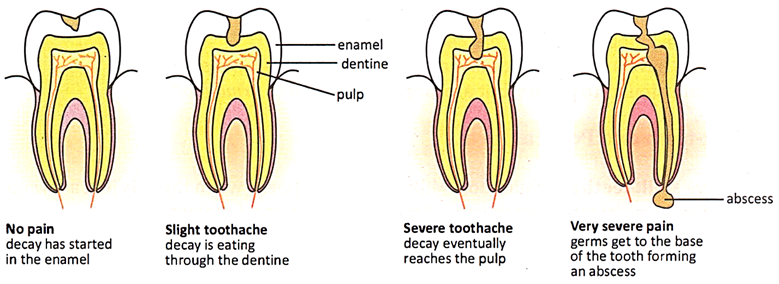
Q.17. With the help of labelled diagram show the gradual decay of tooth.
Ans.
Q.18. Name the various components of food and their simpler forms.
Ans. The various components of food and their simpler forms are
|
Components of food |
Simpler form |
|
Carbohydrate |
Glucose |
|
Fats |
Fatty acids and glycerol |
|
Proteins |
Amino acids |
|
Vitamins |
Vitamins |
|
Minerals and water |
Minerals and water |
Q.19. Susie got her gall bladder removed surgically as she was diagnosed with stones in her gall bladder. After the surgery, she faced problems in digestion of certain food items when consumed in bulk. Can you tell which kind of food items would they be and why?
Ans. After surgical removal of gall bladder, Susie would face problems in digestion of fat and fatty substances when consumed in bulk. This is because the bile juice stored in the gall bladder helps in digestion of fats.
Q.20. Discuss the various associated glands of digestive system and their role in digestion.
Ans. The various associated glands of digestive system and their role in digestion are as follows
(i) Salivary gland digestion of starch in mouth.
(ii) Liver secretes bile juices which help in the digestion of fats.
(iii) Pancreas secretes pancreatic juices which act on carbohydrate, fats and proteins and change them into simpler compounds.
Q.21. Deepak took some grains of boiled rice in test tube 'A' and Rashi took boiled and chewed rice in test tube 'B'. Both of them poured 1-2 drops of iodine solution into the test tube and observed the colour change. What colour change would they have observed? Give reasons for your answer.
Ans. In test tube A, blue black colour appeared because of presence of starch. In test tube B, colour of iodine will not change because of digestion of starch into sugars by the action of saliva in our mouth.
Q.22. Mention the different steps of nutrition in animals.
Ans.
Ingestion
Digestion
Absorption
Assimilation
Egestion
Q.23. List the preventive measures that one should adopt for avoiding tooth decay.
Ans.. Tooth decay can be prevented by:
• reducing the intake of sweets, sugary foods and aerated drinks such as colas
• brushing our teeth regularly and after every meal
• changing our toothbrush when the bristles become soft
• not sharing our toothbrush with anyone
• using fluoride toothpaste as it not only helps to strengthen the enamel but also to resist the effect of acids released by bacteria.
• visiting a dentist regularly once in every six months to get the teeth and gums examined.
Q.24. Write the difference between milk teeth and permanent teeth.
Ans. The difference between milk teeth and permanent teeth are
|
Milk teeth |
Permanent teeth |
|
They grow during infancy, i.e., when one is small baby. |
They grow at the age of 6-8 years. |
|
They are also called as temporary teeth because these are lost at the age of 6-8 years. |
They do not fall till the old age. |
|
They can be replaced by permanent teeth. |
If these teeth fall down no new teeth arises on its place. |
Q.25. Complete the following table, from the options given below:
(Scraping, chewing, siphoning, capturing and swallowing, sponging, sucking, etc.)
|
Kind of food |
Mode of feeding |
|
|
Snail |
|
|
|
Ant |
|
|
|
Eagle |
|
|
|
Humming bird |
|
|
|
Lice |
|
|
|
Mosquito |
|
|
|
Butterfly |
|
|
|
Housefly |
|
|
Ans. The complete table is
|
Name of Animal |
Kind of food |
Mode of feeding |
|
Snail |
Leaves and insects |
Scrapping |
|
Ant |
Food particles |
Chewing |
|
Eagle |
Small animals (Flesh) |
Capturing and swallowing |
|
Humming bird |
Nectar of flowers |
Sucking |
|
Lice |
Blood |
Sucking |
|
Mosquito |
Blood |
Sucking |
|
Butterfly |
Nectar of flowers |
Siphoning |
|
Housefly |
Any edible item |
Sponging |
Q.26. Briefly describe the mechanism of producing hiccups while we take food in hurry.
Ans. Our windpipe (that carries air from nostril to our lungs) and food pipe runs adjacent to each other. Air and food share a common passage in the throat. When we swallow food, a flap-like valve, called epiglottis, closes the passage of the windpipe and guides the food into the food pipe. But if we laugh or talk while eating, the windpipe remains open and food particle enters into the windpipe and we experience hiccups, cough or choking sensation.
Q.27. Deepak and Rashi were eating their food hurriedly so that they could go out and play during the recess. Suddenly, Deepak started coughing violently. Think of the reasons, why he was coughing and discuss with your friends?
Ans. Sometimes when we eat hurriedly, talks or laughs while eating, the flap-like valve (called epiglottis) which closes the passage of windpipe remains open. Therefore, the food may enter into the windpipe. Coughing helps to clear the passage and returns the food particle back to the food pipe.
Q.28. Gastric glands in stomach release hydrochloric acid, enzyme pepsin and mucus. What will happen if mucus is not secreted by the gastric glands?
Ans. Mucus protects the inner lining of stomach form the action of hydrochloric acid and enzyme pepsin. If mucus is not released, it will lead to erosion of inner lining of stomach leading to acidity and ulcers.
Q.29. Choose the odd one out from each group and give reasons.
(a) liver, salivary gland, starch, gall bladder
(b) stomach, liver, pancreas, salivary gland
(c) tongue, absorption, taste, swallow
(d) oesophagus, small intestine, large intestine, rectum
Ans.
(a) Starch, because rest all are glands, and starch is a type of carbohydrate.
(b) Stomach, because rest all are digestive glands and stomach is a digestive organ.
(c) Tongue, because rest all are digestive processes and tongue is a part of digestive system.
(d) Small intestine, because it carries the process of digestion and rest are not involved in digestion.
Q.30. Following statements describe the five steps in animal nutrition. Read each statement and give one word for each statement. Write the terms that describe each process.
(a) Transportation of absorbed food to different parts of body and their utilisation.
(b) Breaking of complex food substances into simpler and soluble substances.
(c) Removal of undigested and unabsorbed solid residues of food from the body.
(d) Taking food into the body.
(e) Transport of digested and soluble food from the intestine to blood vessels.
Ans.
(a) Assimilation
(c) Egestion
(e) Absorption
(b) Digestion
(d) Ingestion
Online Tuitions & Self-Study Courses for Grade 6 to 12 & JEE / NEET