
Class 7 Civics
Chapter 1 – On Equality
NCERT Solutions
Q.1. In a democracy, why is Universal Adult Franchise Important?
Ans: Universal Adult Franchise means that all the adults who are 18 years of age and above, have the right to vote, irrespective of their religion, caste, colour, race, economic and educational conditions. The concept of universal adult franchise is based on equality and in a democracy every citizen is equal.
Q.2. In reference of Article 15, state two ways in which it addresses inequality?
Ans: Article 15 of the Indian Constitution addresses inequality and discrimination by
• allowing access to shops, public places, hotels, restaurants and places of public entertainment.
• allowing general public to use the wells, tanks, bathing ghats and roads maintained fully or partly by state funds.
Q.3. In what ways was Omprakash Valmiki's experience similar to that of the Ansaris?
Ans: Omprakash Valmiki's experience was similar to that of the Ansari's in the following ways
• Both were discriminated as Omprakash Valmiki was not permitted to sit with other students and was forced to sweep the school, whereas, the Ansaris were not given a flat in locality because of their religion.
• Omprakash Valmiki faced discrimination because he was a dalit i.e. belonged to a 'lower caste' and the Ansaris faced inequality because of their religion.
In both cases, dignity of a person was violated.
Q.4. What do you understand by the term "all persons are equal before the law"? Why do you think it is important in democracy?
Ans: "All persons are equal before the law", means each and every person, that is, from the President of the country to the domestic workers like Kanta, should be treated equally and have to follow the same laws. The Indian Constitution recognises every person as equal which means that every individual whether male or female from all castes, religions, tribes, educational and economic backgrounds should be considered equal.
Equality is important in a democracy as democracy is the government of the people, by the people and for the people. Equality influences all aspects of democratic functioning.
Q.5. The Government of India passed the Disabilities Act in 1995. This law states that persons with disabilities have equal rights and that the government should make possible their full participation in society. The government has to provide free education and integrate children with disabilities into mainstream schools. This law also states that all public places including buildings, schools, etc should be accessible and provided with ramps.
Look at the photograph and think about the boy who is being carried down the stairs. Do you think the above law is being implemented in his case? What needs to be done to make the building more accessible for him? How would his being carried down the stairs affect his dignity as well as his safety?
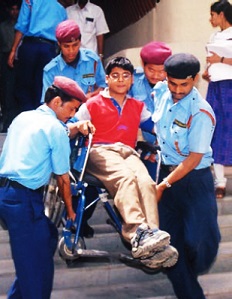
Ans: No, the Disabilities Act, 1995 is not being implemented in this case. The building is not accessible for him and in order to make it possible ramps should be constructed.
In the above picture, the boy's dignity is overlooked as he's being carried down by others, which may make him feel dependent on others. It also affects his safety as he may anytime fall from the chair due to negligence and incapacity.
Questions from within the Chapter
Q.1. Do you think Kanta has enough reason to doubt whether she really is equal? List three reasons from the story that might make her feel like this.
Ans: Yes, Kanta has enough reason to doubt whether she really is equal. The three reasons from the story that might make her feel like this are
• She is poor and lives in a slum.
• Her daughter is sick but she cannot take the day off from work.
• She has to stand in a long queue in front of the government hospitals before she can take her daughter to the doctor.
Q.2. Circle the reference to caste in the matrimonial advertisements given below.
• ALLIANCE invited, for 32/MMS/5'4"/fair/b'ful girl working in IT Co . Mumbai from BE/MBA by working in Mumbai/Abroad from IT Industry Caste no bar. SC/ST excuse. Send BHP (must).
• PROF Qlfd B'ful tall girl 4 Gupta Boy 28/6 CA Working MNC TXS USA and 80k.
• TAMIL BRAHMIN Iyengar groom, 1981 born, Naithruvakashyapa Goth-ram, Swathi Star, 180 cms, tall, fair.
Ans: Caste no bar, SC/ST excuse, Gupta boy, Tamil Brahmin Iyengar.
Q.3. Why do you think Omprakash Valmiki was being treated unequally by his teacher and his classmates? Imagine yourself as Omprakash Valmiki and write four lines about how you would feel if you were in the same situation as him.
Ans: Omprakash Valmiki was being treated unequally by his teacher and his classmates because he was a Dalit and dalit means 'broken' and one who belong to lower castes.
If I would have been in situation as of Omprakash Valmiki, I would have felt embarrassed and ashamed over the unfair treatment given to me Dalits are also human beings and should be given equal treatment.
Q.4. Why do you think the Ansaris were being treated unequally? What would you do if you were in the Ansaris position and could not find a place to live because some people did not want to live next to you because of the religion you practice?
Ans: The Ansaris were being treated unequally because of their Muslim religion. They were discriminated and were not given place to live because they belonged to the minority community. If I was in Ansari’s position, I would have told the landlord that all religions lead to one God. Also, I would have filed a complaint to the Minorities Commission against the apartment owners.
Q.5. If you were one of the Ansaris, how would you have responded to the suggestion that you change your name?
Ans: If I was in the place of Ansari. I would have refused to change my name, as changing my identity will hurt my dignity.
Q.6. Can you think of an incident in your life in which your dignity was violated? How did this make you feel?
Ans: Yes. I felt disgusted and disheartened.
Q.7. What is the Mid-day Meal Programme? Can you list three benefits of the programme? How do you think this programme might help promote greater equality?
Ans: Mid-day Meal Programme is an initiative taken by government in order to provide children of elementary schools with cooked lunch all over the country.
Three benefits of the programme are
• Greater number of poor children have begun enrolling and regularly attending school.
• It also helped in reducing the hunger of poor students who cannot concentrate on their studies because of empty stomachs.
• The programme also helped in improving the attendance of the students.
This programme will also help in promoting equality as it will help in reducing caste prejudices as both lower and upper caste children will sit together to have their meals. In some places, dalit women have been employed to cook the meals.
Q.8. Find out about one government scheme in your area. What does this scheme do? Whom in this scheme set-up to benefit?
Ans: Kasturba Gandhi Balika Vidyalaya is a government scheme. This scheme is set-up to benefit the girl child belonging to SC/ST, OBC, and minority communities and families below the poverty line in educationally backward areas.
Online Tuitions & Self-Study Courses for Grade 6 to 12 & JEE / NEET