
Class 7 Science
Chapter 1 – Nutrition in Plants
Assignment 3
Q.1. (a) Why a crop field needed to be replenished with nutrients from time to time? By which methods farmers replenish nutrients in a crop field?
(b) Some plants have deep red, violet or brown leaves. Can these leaves also carry out photosynthesis?
Q.2. (a) Explain the role of leaves in a plant.
(b) Define parasitic mode of nutrition with examples.
(c) What is the role of bacteria and fungi in cleaning of our environment?
Q.3. What is photosynthesis? Explain the process of photosynthesis with the help of a neat and labelled diagram.
Q.4. (a) Naveen is a farmer. He does not want to use chemical fertilizers in his farm due to their harmful effects on environment. What suggestion would you give him to increase the fertility of his farmland?
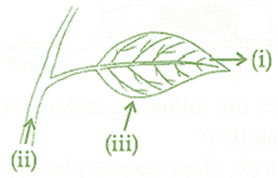
(b) Labels (i), (ii) and (iii) in the given diagram indicate things that green plants take in or give out when they make food. Identify them.
(c) How are bacteria both useful and harmful to humans?
Q.5. (a) How do plants get nitrogen to synthesize proteins?
(b) Three tubes (A, B and C) as shown in the figure, were left in sunlight for one hour. Each test tube was provided with a bicarbonate indicator.
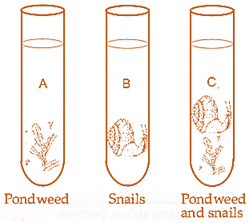
Bicarbonate indicator stays red if there is no change in carbon dioxide concentration. The indicator becomes yellow if carbon dioxide is added and purple if carbon dioxide is removed.
The bicarbonate indicator in each tube was red at the start of the experiment.
Explain how does the change in colour of the indicator occur in different test tubes.
Q.6. (a) Take a potted plant with broad leaves. Take two square strips of black paper. Cover a part of a leaf with these papers and secure it with paper clips. Keep the plant in the sunlight for 2-5 days. Now, answer the following questions:
(i) What is the difference in the colour of the covered and the uncovered parts of the leaf?
(ii) Perform iodine test on this leaf. Did the two parts show any difference in results?
(iii) Now, remove the strip and expose the covered part to the sunlight for 2-3 days and do the iodine test again. What will you observe?
(b) Write about the roles of the following:
(i) Stomata
(ii) Chlorophyll
Q.7. Give reasons for the following:
(i) Venus flytrap and pitcher plant perform photosynthesis, yet they trap insects.
(ii) Fungi can be useful as well as harmful for humans.
Online Tuitions & Self-Study Courses for Grade 6 to 12 & JEE / NEET