
Magnet: The objects which attract things made of some metals like iron, steel, nickel and cobalt are known as magnets.
Magnets are made of iron, steel or other alloys of iron by the process of magnetisation.
Magnets made in this way are called artificial magnets or man-made magnets.
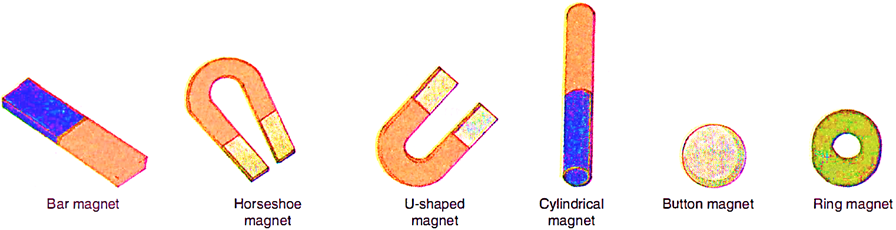
A bar magnet is a long rectangular magnetised bar of iron or steel.
Some of the other types of magnets are horseshoe magnet, U-shaped magnet, cylindrical magnet (or rod magnet), button magnet and ring magnet.
It is said that, there was a shepherd named Magnes, who lived in ancient Greece. He used to take his herd of sheep and goats to the nearby mountains for grazing.
One day he was surprised to find that he had to pull hard to free his stick from a rock on the mountainside. It seemed as if the stick was being attracted by the rock. The rock was a natural magnet and it attracted the iron tip of the shepherd's stick. Such rocks were given the name magnetite after the name of that shepherd. Magnetite contains iron.
Some people believe that magnetite was first discovered at a place called Magnesia in Turkey.
Magnetic Materials and Non-Magnetic Materials
Those materials which are attracted by a magnet are called magnetic materials. Iron, steel, nickel and cobalt are attracted by a magnet, so iron, steel, nickel and cobalt are magnetic materials.
All the materials other than iron, steel, nickel and cobalt are non-magnetic materials. For example, wood, plastic, rubber, paper, cloth, glass, leather, thermocol, copper, aluminium, brass, lead, stone, diamond, graphite, paint, charcoal, air, water, skin and bones, etc.
Non-magnetic materials cannot be magnetised (i.e., cannot be converted into magnets).
Magnetism can pass through non-magnet materials
The pull (or attraction or magnetism) of magnets can pass through nonmagnetic materials like plastic, paper, cardboard, wooden plank, air, paint, skin and bone, etc.
The pull (or attraction or magnetism) of magnets cannot pass through magnetic materials like iron and steel objects.
Activity to show that magnetism can pass through non-magnetic materials
Take a plastic cup (or paper cup) and fix it on a wooden stand with the help of a clamp.
Place a magnet inside the plastic cup and cover it with a plastic lid.
Take a short piece of thread and tie its one end to a paper clip of steel. The other end of thread is tied to a nail fixed on the base of the wooden stand exactly below the plastic cup.
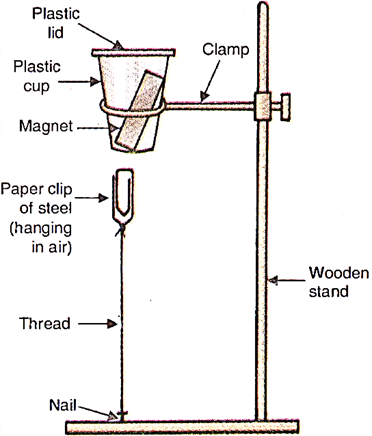
Hold the paper clip in your hand and bring it up to a little distance below the bottom of the plastic cup containing magnet and then release the paper clip.
We will observe that the paper clip remains hanging in air like a kite a little distance below the plastic cup without any support.
It shows that the force of attraction exerted by the magnet kept inside the plastic cup passes through the plastic bottom of the cup as well as through the air below the cup and holds the paper clip.
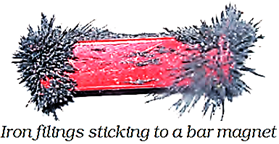
The regions of a magnet where the attraction of magnet is the strongest are called poles of the magnet.
Irrespective of its shape, a magnet always has two poles. The two poles of a magnet are near its free ends.
The two poles of a magnet are always different. One pole of the magnet is called north pole (N) and the other pole of magnet is called south pole (S).
The north pole and south pole of a magnet always exist together. Every magnet, whether big or small, has a north pole and a south pole. It is impossible to have a magnet having only one pole.
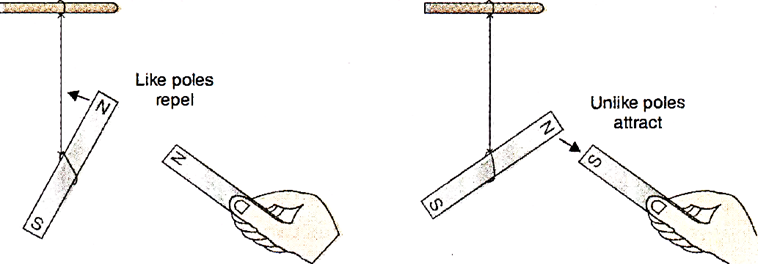
The same type of magnetic poles are called like poles. For example, a 'North pole' and another 'North pole' are like poles. Similarly, a 'South pole' and another 'South pole' are also like poles. Like poles repel each other.
The different types of magnetic poles are called unlike poles. For example, a 'North pole' and a 'South pole' are unlike poles. Unlike magnetic poles attract each other.
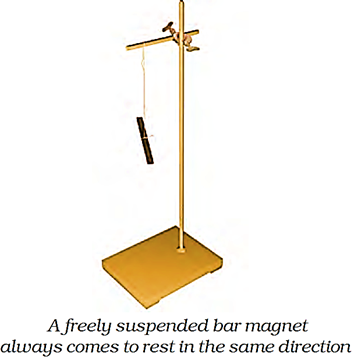
(i) A freely suspended magnet always points in the north-south direction.
The end of magnet which points towards the north direction is called north pole of the magnet.
The end of magnet which points towards the south direction is called south pole of the magnet.
If a bar magnet is freely suspended, it will swing until its one end points towards the north pole of earth and the other towards the south pole of the earth.
If, however, a wooden scale, a plastic scale, an iron bar, a copper plate or an aluminium rod are freely suspended by using thread, they do not always come to rest pointing along the same direction (north-south direction).
(ii) Like magnetic poles repel each other; unlike magnetic poles attract each other.
If two magnets are brought close together then like magnetic poles will repel each other and unlike magnetic poles will attract each other.
Activity to show that like poles repel each other and unlike poles attract each other
1. Let us bring the north pole of the hand-held magnet near the north pole of the suspended magnet. We will find that the north pole of the suspended magnet moves away from the north pole of our hand-held magnet. This means that the north pole of one magnet repels the north pole of the other magnet. Similarly, if we bring the south pole of the hand-held magnet near the south pole of the suspended magnet, even then the south pole of suspended magnet moves away showing that the south pole of one magnet repels the south pole of another magnet.
2. We now bring the south pole of the hand-held magnet near the north pole of the suspended magnet. We find that the north pole of the suspended magnet moves towards the south pole of our hand-held magnet. This means that the south pole of one magnet attracts the north pole of another magnet. Similarly, if we bring the north pole of the hand-held magnet near the south pole of the suspended magnet, even then the south pole of the suspended magnet moves towards the north pole of the hand-held magnet showing that the north pole of one magnet attracts the south pole of another magnet.
Suppose we are given two identical bars of iron, one of which is a magnet and the other is an ordinary bar of iron. We want to find out which of them is a magnet.
We can do this by using any object made of iron or steel (such as a paper clip or safety pin) as follows:
Take both the identical bars of iron near a paper clip, one by one.
(i) The iron bar which attracts (or pulls) the paper clip so that the paper clip sticks to it, will be a magnet.
(ii) The iron bar which does not attract (or pull) the paper clip will be an ordinary bar of iron and not a magnet.
A compass is usually a small box with a glass cover on it. A magnetised needle is pivoted inside the box, which can rotate freely. The compass also has a dial with directions marked on it.
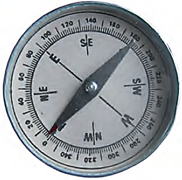
The compass is kept at the place where we wish to know the directions. Its needle indicates the north-south direction when it comes to rest. The compass is then rotated until the north and south marked on the dial are at the two ends of the needle. To identify the north-pole of the magnetic needle, it is usually painted in a different colour.
Activity to make your own magnet
Take an iron bar (or an iron strip) which is to be made a magnet and keep it on a wooden table. Also take a bar magnet. Hold one end of the bar magnet in your hand and keep the other end of bar magnet at one end A of the iron bar. Without lifting, move the lower end of bar magnet along the whole length of iron bar till you reach its other end B. After reaching end B, lift the bar magnet and bring its same end (or same pole) again at the starting end A of the iron bar.
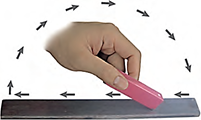
Move the bar magnet again along the whole length of iron bar in the same direction (from A to B) as you did before. Repeat this process of stroking the iron bar with the same end of bar magnet in the same direction about 30 to 40 times. The iron bar will then become a magnet. We can check whether the iron bar has become a magnet or not by bringing it near iron filings (or paper clips). If the iron filings (or paper clips) cling to the end of the iron bar, then it has become a magnet. If not, then we should continue the process of stroking the iron bar with bar magnet for some more time in the same way as before.
Activity to Make Our Own Compass
We take an iron needle (or steel needle) and turn it into a magnet by using a bar magnet. This iron needle which has become a magnet is known as 'magnetised needle'. Insert the magnetised iron needle through a small cork in such a way that some part of it is visible on both the sides of the cork.
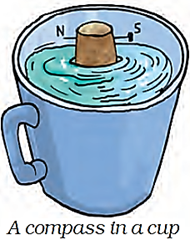
Now, take some water in a plastic container and float the cork (carrying magnetised needle) in water. The needle should remain above the water level. It should not touch the water in the container. The magnetised iron needle fixed in the cork floating on water has become a compass. The magnetised iron needle will align itself along the north-south direction. Rotate the floating cork carrying the magnetised needle in different directions and then release it.
When the cork stops rotating, the magnetised iron needle always aligns along north-south direction. We can paint the north pole of the magnetised iron needle for identification.
Magnets can also be made by using electricity. The magnets made by using electricity are called electromagnets. Electromagnets are very useful because their magnetism (power of attraction) can be switched 'on' or 'off' as desired.
Precautions in Handling Magnets
The magnets lose their property of magnetism if they are heated strongly, hit with a hammer or dropped from a height.
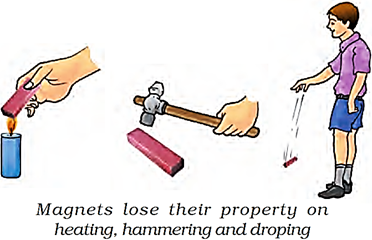
Following precautions should be taken while handling magnets so that they do not get damaged and retain their magnetism for a much longer period.
(i) We should never heat a magnet over a burner.
(ii) We should never hit a magnet with a hammer.
(iii) We should never drop a magnet on the floor.
(iv) We should store the magnets properly (when not in use).
The magnets tend to lose their magnetism gradually and become weak over a period of time if they are not stored properly. To prevent the loss of magnetism, the magnets should be stored properly when not in use. This is done as follows.
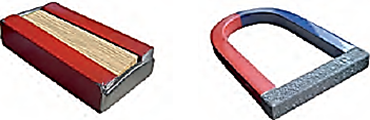
(i) The bar magnets are stored in pairs (separated by a piece of wood) with their unlike poles on the same side and bars of soft iron kept across their ends.
The soft iron bars kept across the ends of two bar magnets are called keepers (because they keep the magnetism of bar magnets safe). Thus, the proper storing of bar magnets in pairs by separating them with a piece of wood and keeping soft iron bars across their opposite ends prevents the loss of their magnetism.
(ii) The horseshoe magnets (or U-shaped magnets) are stored properly just by keeping a bar of soft iron across their ends. Since a horseshoe magnet has both its poles (N-pole and S-pole) on the same side, so one horseshoe magnet requires only one soft iron bar for its proper storage. Thus, horseshoe magnets are stored singly and not in pairs.
Keep magnets away from cassettes, mobiles, television, music system, compact disks (CDs) and the computer.
(i) Magnets are used to hold objects (like stickers, refrigerator doors, pencil box lids, pins, etc.).
(ii) Magnets are used to separate discarded iron and steel objects from other waste (non-magnetic) materials.
(iii) Magnets are used for making compasses.
(iv) Magnets are used in telephones, hair driers, door bells, mixer and grinder, fans, washing machines, television sets, tape recorders, electric motors, electric generators and various types of toys.
Online Tuitions & Self-Study Courses for Grade 6 to 12 & JEE / NEET