
Class 7 Science
Chapter 12 – Reproduction in Plants
Very Important Questions Answers
Q.1. Which of the following contains the egg cells in plants?
(a) anther
(b) stigma
(c) pollen grain
(d) ovule
Ans: (d) ovule
A pistil of a flower has three parts: stigma, style and ovary. The ovary contains one or more ovules. The egg is formed in an ovule.
Q.2. Which of these develops into the seed?
(a) pollen grain
(b) ovary
(c) ovule
(d) pollen tube
Ans: (c) ovule
After fertilisation in plants, ovary grows into a fruit while the seeds develop from the ovules.
Q.3. A plant was found to have seeds with hooks. By which method is it most likely to be dispersed?
(a) wind
(b) water
(c) animals
(d) explosion of fruit.
Ans: (c) animals
Seeds with hooks are dispersed by animals. These seeds get attached to the bodies of animals and are carried to distant places.
Q.4. Which of the following is dispersed by water?
(a) lotus
(b) dandelion
(c) pea
(d) xanthium
Ans: (a) lotus
Lotus plant grows near water. Its fruit can float on water. When the fruits of lotus fall in the water, currents carry them too far away to land areas.
Q.5. Which of the following is an incomplete flower?
(a) rose
(b) apple
(c) sweet pea
(d) papaya
Ans: (d) papaya
A flower having all the four types of floral organs—that is, sepals, petals, stamens and pistils—is termed as complete flower. The absence of any one or more of the floral organs makes the flower incomplete.
Q.6. In plants, sexual reproduction occurs in which of the following?
(a) leaf
(b) flower
(c) fruit
(d) stem
Ans: (b) flower
Flowers are the reproductive parts of a plant. Leaf and stem are vegetative parts of a plant. The fruit is the ripened ovary.
Q.7. Which of the following methods of reproduction is sexual?
(a) vegetative reproduction
(b) spore formation
(c) budding
(d) none of these
Ans: (d) none of these
All of the given options are modes of asexual reproduction in plants.
Q.8. Yeast reproduces by
(a) budding
(b) spore formation
(c) vegetative reproduction
(d) sexual reproduction
Ans: (a) budding
Yeast reproduces by budding. A bud is a small bulb-like projection coming out from yeast cell. The bud gradually grows and gets detached from the parent cell and forms a new yeast cell.
Q.9. Zygote is related to which method of reproduction?
(a) budding
(b) sexual reproduction
(c) spore formation
(d) vegetative reproduction
Ans: (b) sexual reproduction
Zygote is formed in sexual reproduction when a male gamete fuses with a female gamete.
Q.10. Which of these is the male reproduction organ in plants?
(a) pistil
(b) pollen grain
(c) stamen
(d) ovule
Ans: (c) stamen
Stamens are the male reproductive part of a flower.
Q.11. Potato reproduces from seeds. True or False?
Ans: False.
Potato reproduces by vegetative propagation.
Q.12. Complete flowers have both male and female organs. True or False?
Ans: True.
Complete flowers have all the four floral organs; that is, sepals, petals, stamens and pistils.
Q.13. A seed cannot start germinating in the absence of water. True or False?
Ans: True.
The seed must get moisture and oxygen for germination. The enzymes in the seed function only when they get water.
Q.14. Improper working of the reproductive organs can lead to death. True or False? Give reasons.
Ans: False.
Reproductive organs are not needed for the organism to stay alive. However, the organism cannot produce offspring without it and therefore cannot continue its species.
Q.15. The process of growing new plants using artificial methods is called _________
Ans: The process of growing new plants using artificial methods is called artificial propagation.
Q.16. The fusion product of male cell and egg cell known as ____________
Ans: The fusion product of male cell and egg cell is known as zygote.
Q.17. The method of reproduction that involves only one parent is called ___________
Ans: The method of reproduction that involves only one parent is called asexual reproduction.
Q.18. Mosses and ferns reproduce by __________ formation.
Ans: Mosses and ferns reproduce by spore formation.
Q.19. Spirogyra reproduces by ___________
Ans: Spirogyra reproduces by fragmentation.
Q.20. You know that in humans, reproduction requires two parents. Is it the same in plants?
Ans: In case of plants, the requirement of two parents is not always necessary for reproduction. Many plants reproduce by asexual methods such as budding, fragmentation and spore formation. These methods do not require two parents.
Q.21. What type of reproduction occurs in the following?
a. Amoeba
b. Yeast
c. Hydra
d. Spirogyra
e. Money plant
Ans:
a. An Amoeba reproduces by the process of asexual reproduction through fission.
b. Yeast also reproduces by asexual reproduction through budding.
c. Hydra performs asexual reproduction and reproduces through budding.
d. Spirogyra reproduces by asexual reproduction through fragmentation.
e. Money plant also performs asexual reproduction through vegetative propagation.
Q.22. New plants grow from both spores and seeds. Both can stay dormant until conditions are favourable, and then start growing. What is the difference between a spore and a seed?
Ans: The differences between a spore and a seed have been summarised as follows:
|
Spore |
Seed |
|
1. Spore is a spherical, tiny structure, which is protected by a relatively thicker wall. |
1. A seed is an embryo which gives rise to the plant. |
|
2. Spores are unicellular. |
2. Seeds are multicellular. |
|
3.Spores are found beneath the leaves of ferns and mosses. |
3. Seeds can be found in the fruits as well as the flowers of flowering plants. |
Q.23. Plants can also be reproduced artificially without the help of any reproductive organs. What is such reproduction in plants called? Give two examples.
Ans: The artificial methods that are used to carry out reproduction in plants without any utilisation of reproductive organs is called artificial propagation. Some examples of artificial propagation are as follows:
1. Grafting: The process of grafting involves tying a bud or twig of a plant (scion) over the stem that has been cut from another plant (stock).
2. Layering: In this process, a relatively younger branch is bent and layered with moist soil. This layered branch later develops its own root system and grows into a new plant.
Q.24. Sexual reproduction in plants always requires two flowers–one male and the other female. Do you agree? Give reasons.
Ans: No, sexual reproduction in plants does not always require one female and another male flower. Some flowers such as sweet pea and rose have bisexual (hermaphrodite) flowers. These flowers are composed of both female and male reproductive parts and can take part in sexual reproduction.
Q.25. What does 'pollination' mean?
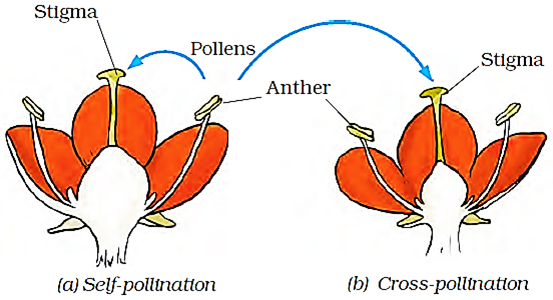
Ans: Pollination is the process, in which the pollen grains present in the anthers are transferred to the stigma of the flower. This process can be carried out by a number of agents such as wind and insects.
Q.26. It is seen that wind-pollinated flowers have either small petals or no petals at all, and that their anthers and pistils are exposed. How does this help the flowers?
Ans: The presence of small petals and exposure of anthers and pistils to the winds, allow these flowers to effectively interact with the wind. The wind can easily carry the pollen from these flowers and help in the pollination of these flowers.
Q.27. After pollination and fertilization in a flower, most often all the parts of the flower fall off except one. Which is this part? What does it develop into?
Ans: The plant part that is retained after the completion of pollination and fertilization is ovary. The ovary eventually swells and develops into a fruit.
Q.28. Plants scatter their seeds far and wide by several methods. Why is scattering necessary?
Ans: The scattering of seeds far away from the plant is necessary because of the following reasons:
1. It ensures that all the seeds get adequate amount of water, sunlight, and minerals.
2. It also prevents the overcrowding of seeds in one place and allows them to obtain enough space and develop into healthy plants.
Q.29. What is the process of fusion of male cell and egg cell called?
Ans: The process of fusion of male cell and egg cell is called fertilisation.
Q.30. Name one seed that is dispersed by:
(a) wind
(b) explosion of fruit
Ans:
(a) Cotton seeds are dispersed by wind.
(b) Pea seeds are dispersed by explosion of fruit.
Q.31. Why is reproduction important?
Ans: Reproduction is the process of producing young ones of their own kind. It is important because life continues from generation to generation through reproduction.
Q.32. Name one reproductive and one vegetative part of a plant.
Ans: Reproductive part of a plant is flower.
Vegetative part of a plant is stem.
Q.33. How does yeast reproduce?
Ans: Yeast reproduces by budding. In yeast, a small amount of cytoplasm accumulates at one end of the cell and a bud is formed. The nucleus divides into two. One of them enters the bud. The bud grows and gets detached from the parent cell to form a new cell.
Q.34. Which plants reproduce by spore formation?
Ans: Plants of lower order such as mosses, ferns and moulds reproduce by spore formation. A spore is protected by a thick wall and grows into a new plant under favourable conditions.
Q.35. How is sexual reproduction different from asexual reproduction?
Ans:
|
Sexual Reproduction |
Asexual Reproduction |
|
Two parents, one male and one female, are required to produce an offspring. |
Only one parent is required to produce an offspring. |
|
Offspring have a mix of inherited genes of both male and female. |
Offspring is identical to the parent. |
|
In plants, sexual reproduction occurs by the formation of seeds. |
In plants, asexual reproduction occurs without seeds. |
Q.36. List the different kinds of asexual reproduction in plants, giving one example of each.
Ans: The different kinds of asexual reproduction in plants are listed below:
(a) Fragmentation (e.g., spirogyra)
(b) Budding (e.g., yeast)
(c) Spore formation (e.g., moss)
Q.37. What is vegetative reproduction?
Ans: The method of producing new plants from the vegetative parts of the mother plant, such as root, stem and leaves, without the assistance of any reproductive organ is called vegetative propagation.
Q.38. What is artificial propagation of plants? Name four methods of artificial propagation.
Ans: Artificial propagation is the process of growing new plants by artificial methods.
Four methods of artificial propagation are grafting, cutting, layering and tissue culture.
Q.39. What does the process of fertilisation consist of?
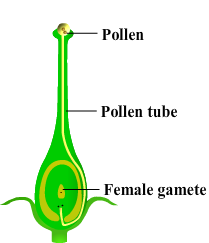
Ans: The process of fertilisation consists of the fusion of male cell, carried by the pollen tube, with the egg in the ovule. Zygote is formed as a result of fertilisation.
Q.40. When does a seed start germinating?
Ans: A seed germinates when it gets proper moisture and oxygen. Most seeds also require warmth for their germination.
Q.41. Discuss, giving examples, three different ways of vegetative reproduction.
Ans: Following are the three different ways of vegetative reproduction:
(a) In some plants, such as strawberry and grasses, the main plant develops side shoots which have buds that grow into new plants.
(b) The leaf of Bryophyllum has many buds on its margin which give rise to new plants.
(c) Bulbs in onion are underground stems with thick leaves. New plants are also produced from bulbs in onion.
Q.42. What are the advantages of vegetative reproduction?
Ans: The various advantages of vegetative reproduction are as follows:
(a) It allows the plant producers to produce new plants quickly.
(b) It produces exact replicas of the parent plant. One can produce exact copies of a plant with the required characteristics, such as resistance to disease.
(c) It requires less attention than plants grown from seeds in the early stages of growth.
(d) It helps to develop new varieties of plants having required characteristics.
Q.43. Why is dispersal of seeds necessary? Name the agents of dispersal giving one example each of a seed that is dispersed by them.
Ans: Dispersal of seeds is necessary so that seeds of a plant get scattered over a large area. If all the seeds of a plant fall at one place, they will not have enough space, water, minerals and the sunlight. Thus, they will not develop into healthy plants.
Following are the different agents of dispersal:
(a) Wind (e.g., cotton and maple seeds)
(b) Water (e.g., lotus seeds)
(c) Animals (Xanthium seeds)
(d) Explosion of fruit (e.g., geranium and balsam seeds)
Q.44. What happens in a flower after fertilization?
Ans: After fertilisation, the petals, sepals and stamens wither away and fall off. Sometimes, style and stigma also fall off. Only the ovary remains. The ovules in the ovary contain a supply of food which is taken by the developing zygote. The zygote begins to grow by cell division and, after some time, becomes an embryo. The walls of the ovules develop hard layers and form seeds. Thus, seeds consist of a young plant, with stored food, sealed within a hard layer.
Q.45. Explain the process of tissue culture.
Ans: Tissue culture is an artificial method of vegetative reproduction. In this method, a piece of tissue is cut off from the growing tip of a plant. The cells are separated and kept in a nutrient medium under controlled conditions. The nutrient medium contains hormones that make the cells divide and form groups of cells. Roots also develop. These are then kept in a different nutrient medium containing hormones that enable shoot to develop. The different plantlets can now be grown in pots of soil. Orchids, chrysanthemum and many other plants are grown by this method.
Q.46. What kind of flowers do you expect to be attractive-insect pollinated flowers or wind pollinated flowers? Why?
Ans: Insect-pollinated flowers are expected to be more attractive because petals of insect-pollinated flowers are scented and coloured. Wind-pollinated flowers have very small petals or no petals at all. This is because they are pollinated by wind and not by insects.
Q.47. Do you think insect-pollinated flowers can also be pollinated by wind? Why?
Ans: Insect-pollinated flowers cannot be pollinated by wind because the anthers and pistils remain covered by petals.
Q.48. During tissue culture of a certain organism, the number of cells double every hour. If we start with 1 cell, how many cells will develop in the culture dish after
(a) 5 hours
(b) 10 hours
(c) 15 hours
Ans:
(a) Number of cells after 5 hours = 25 = 32
(b) Number of cells after 10 hours = 210 = 1,024
(c) Number of cells after 15 hours = 215 = 32,678
Q.49. After reading about potato farming in tyres, Mohini started growing potatoes at home. Initially she did not get a good crop, but she kept on trying and ultimately learnt how to grow good potatoes. She now contributes several kilograms of potatoes to her kitchen, and thus helps save money. What values did Mohini show?
Ans: Mohini is a smart, intelligent and caring person. She uses tyres for potato farming and thus helps in recycling them. She is smart and intelligent as she uses her knowledge to grow potatoes and save her money as well.
Q.50. Explain the following:
(a) cutting
(b) layering
(c) grafting
Ans:
(a) Cutting: It is an artificial method of vegetative propagation in which a healthy young branch of a plant with leaf buds is cut off and planted in moist soil. The cutting develops roots and grows into a new plant. This method is used to propagate plants such as rose, sugarcane and bougainvillaea.
(b) Layering: It is an artificial method of vegetative propagation in which a young branch is bent towards the ground and covered with moist soil. After some time, roots develop from the covered part. This is called a layer. The branch can now be cut and made to grow into a new plant. This method is used to propagate plants such as rose, jasmine and bougainvillaea.
(c) Grafting: It is an artificial method of vegetative propagation. It consists of keeping a twig or bud of one plant (called the scion) over the cut stem of another plant (called the stock) and tying them up together. The tissues of the stock and scion join together to form one plant. This method is used to develop new varieties of fruit plants such as mango.
Q.51. What is pollination? How does it lead to fertilization? Explain with the help of a diagram.
Ans: Pollination is the process of transfer of pollen grains from the anthers to the stigma. After reaching the stigma, pollen grain starts to grow. A thin tube called the pollen tube grows down from the pollen grain through the pistil. The pollen tube carries the male cell. It grows and enters the ovule. The male cell moves into the ovule and fuses with the egg to form zygote. The fusion of male cell with the egg is called fertilisation.
Online Tuitions & Self-Study Courses for Grade 6 to 12 & JEE / NEET