
Class 6 Maths NCERT Solutions
Chapter 10 Mensuration
Exercise 10.1
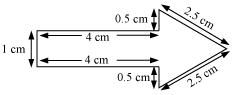
Q.1: Find the perimeter of each of the following figures:
(a)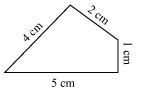 (b)
(b) 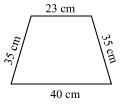
(c)
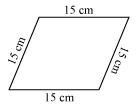 (d)
(d) 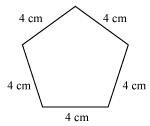
(e)
 (f)
(f) 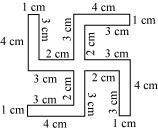
Ans: Perimeter of a polygon is equal to the sum of the lengths of all sides of that polygon.
(a) Perimeter
= (4 + 2 +1 + 5) cm
= 12 cm
(b) Perimeter
= (23 + 35 + 40 + 35) cm
= 133 cm
(c) Perimeter
= (15 + 15 + 15 + 15) cm
= 60 cm
(d) Perimeter
= (4 + 4 + 4 + 4 + 4) cm
= 20 cm
(e) Perimeter
= (1 + 4 + 0.5 + 2.5 + 2.5 + 0.5 + 4) cm
= 15 cm
(f) Perimeter
= (1 + 3 + 2 + 3 + 4 + 1 + 3 + 2 + 3 + 4 + 1 + 3 + 2 + 3 + 4 + 1 + 3 + 2 + 3 + 4)
= 52 cm
Q.2: The lid of a rectangular box of sides 40 cm by 10 cm is sealed all round with tape. What is the length of the tape required?
Ans:
Length (l) of rectangular box = 40 cm
Breadth (b) of rectangular box = 10 cm
Length of tape required = Perimeter of rectangular box
= 2 (l + b) = 2(40 + 10) = 100 cm
Q.3: A table-top measures 2 m 25 cm by 1 m 50 cm. What is the perimeter of the table-top?
Ans:
Length (l) of table-top
= 2 m 25 cm
= 2 + 0.25
= 2.25 m
Breadth (b) of table-top
= 1 m 50 cm
= 1 + 0.50
= 1 .50 m
Perimeter of table-top
= 2 (l + b)
= 2 × (2.25 + 1.50)
= 2 × 3.75 = 7.5 m
Q.4: What is the length of the wooden strip required to frame a photograph of length and breadth 32 cm and 21 cm respectively?
Ans:
Length (l) of photograph = 32 cm
Breadth (b) of photograph = 21 cm
Length of wooden strip required = Perimeter of Photograph
= 2 × (l + b)
= 2 × (32 + 21)
= 2 × 53
= 106 cm
Q.5: A rectangular piece of land measures 0.7 km by 0.5 km. Each side is to be fenced with 4 rows of wires. What is the length of the wire needed?
Ans:
Length (l) of land = 0.7 km
Breadth (b) of land = 0.5 km
Perimeter = 2 × (l + b)
= 2 × (0.7 + 0.5)
= 2 × 1.2
= 2.4 km
Length of wire required = 4 × 2.4 = 9.6 km
Q.6: Find the perimeter of each of the following shapes:
(a) A triangle of sides 3 cm, 4 cm and 5 cm.
(b) An equilateral triangle of side 9 cm.
(c) An isosceles triangle with equal sides 8 cm each and third side 6 cm.
Ans:
(a) Perimeter = (3 + 4 + 5) cm
= 12 cm
(b) Perimeter of an equilateral triangle = 3 × Side of triangle
= (3 × 9) cm
= 27 cm
(c) Perimeter = (2 × 8) + 6
= 22 cm
Q.7: Find the perimeter of a triangle with sides measuring 10 cm, 14 cm and 15 cm.
Ans:
Perimeter of triangle = Sum of the lengths of all sides of the triangle
Perimeter = 10 + 14 + 15
= 39 cm
Q.8: Find the perimeter of a regular hexagon with each side measuring 8 m.
Ans:
Perimeter of regular hexagon
= 6 × Side of regular hexagon
= 6 × 8
= 48 m
Q.9: Find the side of the square whose perimeter is 20 m.
Ans:
Perimeter of square = 4 × Side
20 = 4 × Side
Side = 20 / 4 = 5 m
Q.10: The perimeter of a regular pentagon is 100 cm. How long is its each side?
Ans:
Perimeter of regular pentagon
= 5 × Length of side
100 = 5 × Side
Side = 100 / 5 = 20 cm
Q.11: A piece of string is 30 cm long. What will be the length of each side if the string is used to form:
(a) a square?
(b) an equilateral triangle?
(c) a regular hexagon?
Ans:
(a) Perimeter = 4 × Side
30 = 4 × Side
Side = 30 / 4 = 7.5 cm.
(b) Perimeter = 3 × Side
30 = 3 × Side
Side = 30 / 3 = 10 cm.
(c) Perimeter = 6 × Side
30 = 6 × Side
Side = 30 / 6 5 cm.
Q.12: Two sides of a triangle are 12 cm and 14 cm. The perimeter of the triangle is 36 cm. What is its third side?
Ans:
Perimeter of triangle = Sum of all sides of the triangle
36 = 12 + 14 + Side
36 = 26 + Side
Side = 36 − 26 = 10 cm
Hence, the third side of the triangle is 10 cm.
Q.13: Find the cost of fencing a square park of side 250 m at the rate of Rs 20 per metre.
Ans:
Length of fence required = Perimeter of the square park
= 4 × Side
= 4 × 250
= 1000 m
Cost for fencing 1 m of square park = Rs 20
Cost for fencing 1000 m of square park = 1000 × 20
= Rs 20000
Q.14: Find the cost of fencing a rectangular park of length 175 m and breadth 125 m at the rate of Rs 12 per metre.
Ans:
Length (l) of rectangular park = 175 m
Breadth (b) of rectangular park = 125 m
Length of wire required for fencing the park = Perimeter of the park
= 2 × (l + b)
= 2 × (175 + 125)
= 2 × 300
= 600 m
Cost for fencing 1 m of the park = Rs 12
Cost for fencing 600 m of the square park = 600 × 12
= Rs 7200
Q.15: Sweety runs around a square park of side 75 m. Bulbul runs around a rectangular park with length 60 m and breadth 45 m. Who covers less distance?
Ans:
Distance covered by Sweety = 4 × Side of square park
= 4 × 75
= 300 m
Distance covered by Bulbul = 2 × (60 + 45)
= 2 × 105
= 210 m
Therefore, Bulbul covers less distance.
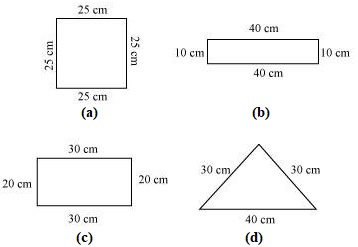
Q.16: What is the perimeter of each of the following figures? What do you infer from the answers?
Ans:
(a) Perimeter of square
= 4 × 25
= 100 cm
(b) Perimeter of rectangle
= 2 × (10 + 40)
= 100 cm
(c) Perimeter of rectangle
= 2 × (20 + 30)
= 100 cm
(d) Perimeter of triangle
= 30 + 30 + 40
= 100 cm
Hence, it can be inferred that all the figures have the same perimeter.
Q.17: Avneet buys 9 square paving slabs, each with a side of ½ m. He lays them in the form of a square.
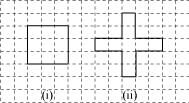
(a) What is the perimeter of his arrangement [figure (i)]?
(b) Shari does not like his arrangement. She gets him to lay them out like a cross. What is the perimeter of her arrangement [figure (ii)]?
(c) Which has greater perimeter?
(d) Avneet wonders if there is a way of getting an even greater perimeter. Can you find a way of doing this? (The paving slabs must meet along complete edges i.e. they cannot be broken.)
Ans:
(a) Side of square =

Perimeter of square =
(b) Perimeter of cross = 0.5 + 1 + 1 + 0.5 + 1 + 1 + 0.5 + 1 + 1 + 0.5 + 1 + 1 = 10 m
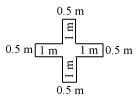
(c) The arrangement in the form of a cross has a greater perimeter.
(d) Arrangements with perimeters greater than 10 m cannot be determined.
Exercise 10.2
Q.1: Find the areas of the following figures by counting square:
|
|
|
|
|
(a) |
(b) |
(c) |
|
|
|
|
|
(d) |
(e) |
(f) |
|
|
|
|
|
(g) |
(h) |
(i) |
|
|
|
|
|
(j) |
(k) |
(l) |
|
|
|
|
|
(m) |
(n) |


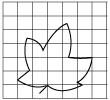
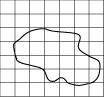
Ans:
(a) The figure contains 9 fully filled squares only. Therefore, the area of this figure will be 9 square units.
(b) The figure contains 5 fully filled squares only. Therefore, the area of this figure will be 5 square units.
(c) The figure contains 2 fully filled squares and 4 half-filled squares. Therefore, the area of this figure will be 4 square units.
(d) The figure contains 8 fully filled squares only. Therefore, the area of this figure will be 8 square units.
(e) The figure contains 10 fully filled squares only. Therefore, the area of this figure will be 10 square units.
(f) The figure contains 2 fully filled squares and 4 half-filled squares. Therefore, the area of this figure will be 4 square units.
(g) The figure contains 4 fully filled squares and 4 half-filled squares. Therefore, the area of this figure will be 6 square units.
(h) The figure contains 5 fully filled squares only. Therefore, the area of this figure will be 5 square units.
(i) The figure contains 9 fully filled squares only. Therefore, the area of this figure will be 9 square units.
(j) The figure contains 2 fully filled squares and 4 half-filled squares. Therefore, the area of this figure will be 4 square units.
(k) The figure contains 4 fully filled squares and 2 half-filled squares. Therefore, the area of this figure will be 5 square units.
(l) From the given figure, it can be observed that,
|
Covered Area |
Number |
Area estimate (sq units) |
|
Fully-filled squares |
2 |
2 |
|
Half-filled squares |
0 |
0 |
|
More than half-filled squares |
6 |
6 |
|
Less than half-filled squares |
6 |
0 |
Total area = 2 + 6 = 8 square units
(m) From the given figure, it can be observed that,
|
Covered Area |
Number |
Area estimate (sq units) |
|
Fully filled squares |
5 |
5 |
|
Half-filled squares |
0 |
0 |
|
More than half-filled squares |
9 |
9 |
|
Less than half-filled squares |
12 |
0 |
Total area = 5 + 9 = 14 square units
(n) From the given figure, it can be observed that,
|
Covered Area |
Number |
Area estimate (sq units) |
|
Fully filled squares |
8 |
8 |
|
Half-filled squares |
0 |
0 |
|
More than half-filled squares |
10 |
10 |
|
Less than half-filled squares |
9 |
0 |
Total area = 8 + 10 = 18 square units
Exercise 10.3
Q.1: Find
the areas of the rectangles whose sides are:
(a) 3 cm and 4 cm
(b) 12 m and 21 m
(c) 2 km and 3 km
(d) 2 m and 70 cm
Ans:
Area of rectangle = Length × Breadth
(a) l = 3 cm
b = 4 cm
Area = l × b = 3 × 4 = 12 cm2
(b) l = 12 m
b = 21 m
Area = l × b = 12 × 21 = 252 m2
(c) l = 2 km
b = 3 km
Area = l × b = 2 × 3 = 6 km2
(d) l = 2 m
b = 70 cm = 0.70 m
Area = l × b = 2 × 0.70 = 1.40 m2
Q.2: Find the areas of the squares whose sides are:
(a) 10 cm
(b) 14 cm
(c) 5 m
Ans:
Area of square = (Side)2
(a) Side = 10 cm
Area = (10)2 =100 cm2
(b) Side = 14 cm
Area = (14)2 = 196 cm2
(c) Side = 5 m
Area = (5)2 = 25 m2
Q.3: The length and breadth of three rectangles are as given below:
(a) 9 m and 6 m
(b) 17 m and 3 m
(c) 4 m and 14 m
Which one has the largest area and which one has the smallest?
Ans:
Area of rectangle = Length × Breadth
(a) l = 9 m
b = 6 m
Area = l × b = 9 × 6 = 54 m2
(b) l = 17 m
b = 3 m
Area = l × b = 17 × 3 = 51 m2
(c) l = 4 m
b = 14 m
Area = l × b = 4 × 14 = 56 m2
We observe that rectangle (c) has the largest area and rectangle (b) has the smallest area.
Q.4: The area of a rectangular garden 50 m long is 300 sq m. Find the width of the garden.
Ans:
Let the breadth of the rectangular garden be b.
l = 50 m
Area = l × b = 300 square m
50 × b = 300
b = 300 / 50 = 6 m
Q.5: What is the cost of tiling a rectangular plot of land 500 m long and 200 m wide at the rate of Rs 8 per hundred sq. m?
Ans:
Area of rectangular plot
= 500 × 200
= 100000 m2
Cost of tiling per 100 m2 = Rs 8
Cost of tiling per 100000 m2 = (8 / 100) × 100000 = Rs 8000
Q.6: A table-top measures 2 m by 1 m 50 cm. What is its area in square metres?
Ans:
Length (l) = 2 m
Breadth (b) = 1 m 50 cm
= (1 + 50/100) m
= 1.5 m
Area = l × b
= 2 × 1.5
= 3 m2
Q.7: A room is 4 m long and 3 m 50 cm wide. How many square metres of carpet is needed to cover the floor of the room?
Ans:
Length (l) = 4 m
Breadth (b) = 3 m 50 cm
= 3.5 m
Area = l × b = 4 × 3.5
= 14 m2
Q.8: A floor is 5 m long and 4 m wide. A square carpet of sides 3 m is laid on the floor. Find the area of the floor that is not carpeted.
Ans:
Length (l) = 5 m
Breadth (b) = 4 m
Area of floor = l × b
= 5 × 4
= 20 m2
Area covered by the carpet = (Side)2
= (3)2 = 9 m2
Area not covered by the carpet
= 20 − 9 = 11 m2
Q.9: Five square flower beds each of sides 1 m are dug on a piece of land 5 m long and 4 m wide. What is the area of the remaining part of the land?
Ans:
Area of the land = 5 × 4 = 20 m2
Area occupied by 5 flower beds = 5 × (Side)2
= 5 × (1)2 = 5 m2
∴ Area of the remaining part = 20 − 5 = 15 m2
Q.10: By splitting the following figures into rectangles, find their areas (The measures are given in centimetres).
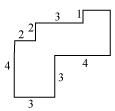
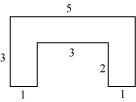
(a) (b)
Ans:
(a) The given figure can be broken into rectangles as follows.
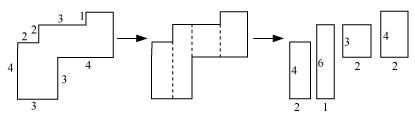
Area of 1st rectangle = 4 × 2 = 8 cm2
Area of 2nd rectangle = 6 × 1 = 6 cm2
Area of 3rd rectangle = 3 × 2 = 6 cm2
Area of 4th rectangle = 4 × 2 = 8 cm2
Total area of the complete figure = 8 + 6 + 6 + 8 = 28 cm2
(b) The given figure can be broken into rectangles as follows.
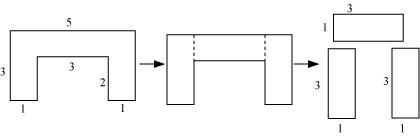
Area of 1st rectangle = 3 × 1 = 3 cm2
Area of 2nd rectangle = 3 × 1 = 3 cm2
Area of 3rd rectangle = 3 × 1 = 3 cm2
Total area of the complete figure = 3 + 3 + 3 = 9 cm2
Q.11: Split
the following shapes into rectangles and find their areas. (The measures are
given in centimetres)
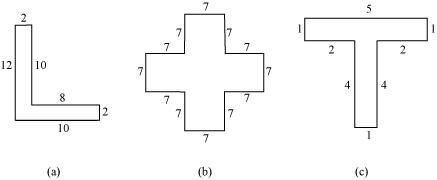
Ans:
(a) The given figure can be broken into rectangles as follows.
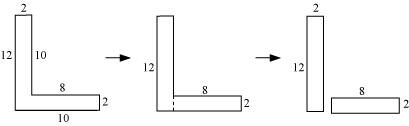
Area of 1st rectangle = 12 × 2 = 24 cm2
Area of 2nd rectangle = 8 × 2 = 16 cm2
Total area of the complete figure = 24 + 16 = 40 cm2
(b) The given figure can be broken into rectangles as follows.
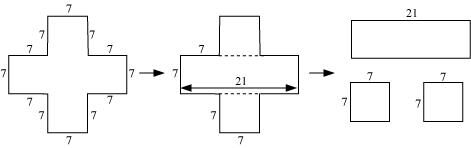
Area of 1st rectangle = 21 × 7 = 147 cm2
Area of 2nd square = 7 × 7 = 49 cm2
Area of 3rd square = 7 × 7 = 49 cm2
Total area of the complete figure = 147 + 49 + 49 = 245 cm2
(c) The given figure can be broken into rectangles as follows.
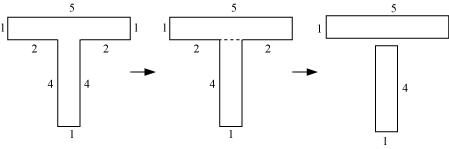
Area of 1st rectangle = 5 × 1 = 5 cm2
Area of 2nd rectangle = 4 × 1 = 4 cm2
Total area of the complete figure = 5 + 4 = 9 cm2
Q.12: How many tiles whose length and breadth are 12 cm and 5 cm respectively will be needed to fit in a rectangular region whose length and breadth are respectively:
(a) 100 cm and 144 cm
(b) 70 cm and 36 cm
Ans:
(a) Total area of the region = 100 × 144 = 14400 cm2
Area of one tile = 12 × 5 = 60 cm2
Number of tiles required = 14400/60 = 240
Therefore, 240 tiles are required.
(b) Total area of the region = 70 × 36 = 2520 cm2
Area of one tile = 60 cm2
Number of tiles required = 2520/60 = 42
Therefore, 42 tiles are required.
End of Questions