
Exercise 7.1
Q.1: Write the fraction representing the shaded portion.
|
|
|
|
|
(i) |
(ii) |
(iii) |
|
|
|
|
|
(iv) |
(v) |
(vi) |
|
|
|
|
|
(vii) |
(viii) |
(ix) |
|
|
||
|
(x) |







Ans :
(i) The given figure represents 2 shaded parts out of 4 equal parts.
Hence,
 .
.
(ii) The given figure represents 8 shaded parts out of 9 equal parts.
Hence,

(iii) The given figure represents 4 shaded parts out of 8 equal parts.
Hence, 
(iv) The given figure represents 1 shaded part out of 4 equal parts.
Hence, 
(v) The given figure represents 3 shaded parts out of 7 equal parts.
Hence, 
(vi) The given figure represents 3 shaded parts out of 12 equal parts.
Hence, 
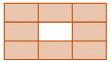
(vii) The given figure represents 10 shaded parts out of 10 equal parts.
Hence, 
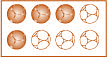
(viii) The given figure represents 4 shaded parts out of 9 equal parts.
Hence, 
(ix) The given figure represents 4 shaded parts out of 8 equal parts.
Hence,
(x) The given figure represents 1 shaded part out of 2 equal parts.
Hence, 
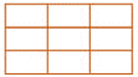
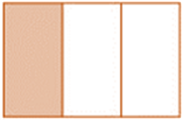
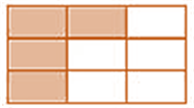
Q.2: Colour the part according to the given fraction.
|
|
|
|
|
(i) |
(ii) |
(iii) |
|
|
|
|
|
(iv) |
(v) |


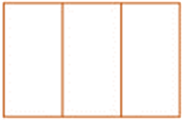



Ans :
(i)

(ii)

(iii)
(iv)

(v)
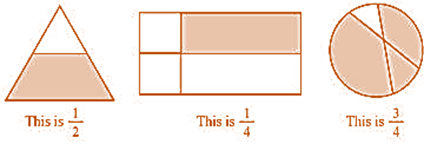
Q.3: Identify the error if any.
Ans :
The given figures do not represent the fractions as here each shape is not divided in equal parts.
Q.4: What fraction of a day is 8 hours?
Ans :
There are 24 hours in a day. Therefore, 8 hours of a day
represent  .
.
Q.5: What fraction of an hour is 40 minutes?
Ans : There
are 60 minutes in an hour. Therefore, 40 minutes of an hour represent  .
.
Q.6: Arya, Abhimanyu, and Vivek shared lunch. Arya has brought two sandwiches, one made of vegetable and one of jam. The other two boys forgot to bring their lunch. Arya agreed to share his sandwiches so that each person will have an equal share of each sandwich.
(a) How can Arya divide his sandwiches so that each person has an equal share?
(b) What part of a sandwich will each boy receive?
Ans :
(a) Arya will divide each sandwich in three equal parts. Then, he will give one part of each sandwich to each one of them.
(b)
Each boy will receive  part of each sandwich.
Q.7: Kanchan dyes dresses. She had to dye 30 dresses. She has so far finished 20 dresses. What fraction of dresses has she finished?
Ans :
Dress dyed so far = 20
Total dresses = 30
Fraction
= 
Q.8: Write the natural numbers from 2 to 12. What fraction of them are prime numbers?
Ans :
Natural numbers from 2 to 12 are 2, 3, 4, 5, 6, 7, 8, 9, 10, 11, and 12.
Prime numbers among these are 2, 3, 5, 7, and 11.
Therefore,
out of 11 numbers, 5 are prime numbers. It represents a fraction  .
.
Q.9: Write the natural numbers from 102 to 113. What fraction of them are prime numbers?
Ans :
Natural numbers from 102 to 113 are 102, 103, 104, 105, 106, 107, 108, 109, 110, 111, 112, 113
Among these numbers, the prime numbers are 103, 107, 109, and 113.
Therefore,
out of 12 numbers, 4 are prime numbers. It represents a fraction  .
.
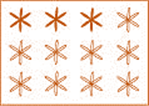
Q.10: What fractions of these circles have X’s in them?

Ans :
Thereare
4 circles, out of 8, having X’s in them. Therefore, it represents a fraction  .
.
Q.11: Kristin received a CD player for her birthday. She bought 3 CDs and received 5 others as gifts. What fraction of her total CDs did she buy and what fraction did she receive as gifts?
Ans :
Total CDs Kristin had on her birthday = 3 + 5 = 8
Out
of 8 CDs, she bought 3 CDs and also got 5 CDs as gifts. Therefore, she bought
and received CDs as gifts in a fraction of  and
and
 respectively.
Exercise 7.2
Q.1: Draw number lines and locate the points on them:
(a)
 (b)
(b)
 (c)
(c) 
Ans :
(a)

(b)

(c)

Q.2: Express the following as mixed fractions:
(a)  (b)
(b)  (c)
(c)

(d)  (e)
(e)  (f)
(f)

Ans :
(a)
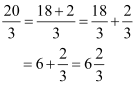
(b)
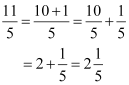
(c)
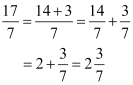
(d)
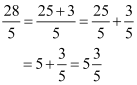
(e)
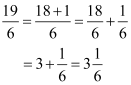
(f)
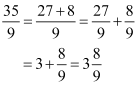
Q.3: Express the following as improper fractions:
(a)  (b)
(b)  (c)
(c) 
(d)  (e)
(e)  (f)
(f) 
Ans :
(a) 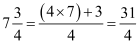
(b) 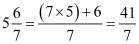
(c) 
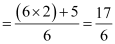
(d) 
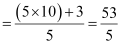
(e) 
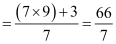
(f) 
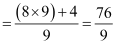
Exercise 7.3
Q.1: Write the fractions. Are all these fractions equivalent?
(a)

(b)

Ans :
(a) In the given circles, 1 out of 2, 2 out of 4, 3 out of 6, and 4 out of 8 equal parts are shaded respectively. Therefore, these circles represent
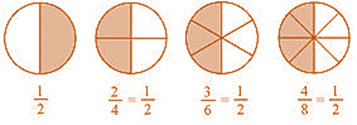
Also, all these fractions are equivalent.
(b) In the given rectangles, 4 out of 12, 3 out of 9, 2 out of 6, 1 out of 3, and 6 out of 15 equal parts (i.e., circles) are shaded respectively. Therefore, these rectangles represent
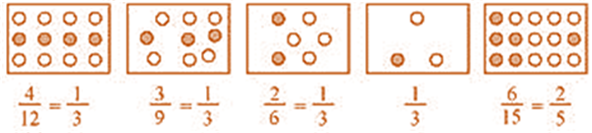
No, not all of these fractions are equivalent.
Q.2: Write the fractions and pair up the equivalent fractions from each row.
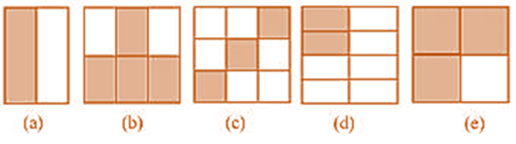
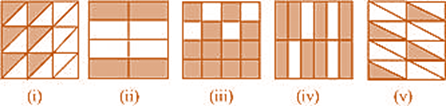
Ans :
(a)
Here, 1 part is shaded out of 2 equal parts (i.e., rectangle). Hence, this figure
represents a fraction .
.
(b)
Here, 4 parts are shaded out of 6 equal parts (i.e., rectangle). Hence, this
figure represents a fraction
(c)
Here, 3 parts are shaded out of 9 equal parts (i.e., squares). Hence, this figure
represents a fraction 
(d)
Here, 2 parts are shaded out of 8 equal parts (i.e., rectangle). Hence, this
figure represents a fraction 
(e)
Here, 3 parts are shaded out of 4 equal parts (i.e., squares). Hence, this figure
represents a fraction  .
.
(i)
Here, 6 parts are shaded out of 18 equal parts (i.e., triangles). Hence, this
figure represents a fraction 
(ii)
Here, 4 parts are shaded out of 8 equal parts (i.e., rectangles). Hence, this
figure represents a fraction 
(iii)
Here, 12 parts are shaded out of 16 equal parts (i.e., squares). Hence, this
figure represents a fraction 
(iv)
Here, 8 parts are shaded out of 12 equal parts (i.e., rectangles). Hence, this
figure represents a fraction 
(v)
Here, 4 parts are shaded out of 16 equal parts (i.e., triangles). Hence, this
figure represents a fraction 
Now, these figures can be matched correctly as
(a) (ii), (b) (iv), (c) (i), (d) (v), (e) (iii)
Q.3: Replace &mnSq2 in each of the following by the correct number:
(a)  (b)
(b) 
(c)  (d)
(d) 
(e) 
Ans :
(a) 

Hence, &mnSq2 can be replaced by 28.
(b) 

Hence, &mnSq2 can be replaced by 16.
(c) 

Hence, &mnSq2 can be replaced by 12.
(d) 

Hence, &mnSq2 can be replaced by 20.
(e) 

Hence, &mnSq2 can be replaced by 3.
Q.4: Find the equivalent fraction of  having
(a) denominator 20 (b) numerator 9
(c) denominator 30 (d) numerator 27
Ans :
(a)
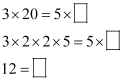
Hence,
the required fraction is .
.
(b) 
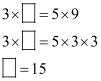
Hence,
the required fraction is .
.
(c) 
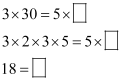
Hence,
the required fraction is .
.
(d) 
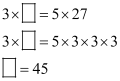
Hence,
the required fraction is .
.
Q.5: Find the equivalent fraction of  with
with
(a) numerator 9 (b) denominator 4
Ans :
(a) 
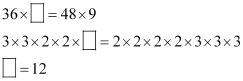
Hence,
the required fraction is .
.
(b) 
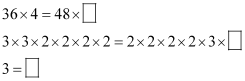
Hence,
the required fraction is.
Q.6: Check whether the given fractions are equivalent:
(a)  (b)
(b) 
(c) 
Ans :
(a) 

Clearly, both the fractions are equivalent.
(b) 
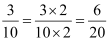
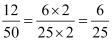
Clearly, both the fractions are not equivalent.
(c) 
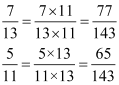
Clearly, both the fractions are not equivalent.
Q.7: Reduce the following fractions to simplest form:
(a)  (b)
(b) 
(c)  (d)
(d) 
(e) 
Ans :
(a) 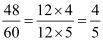
(b) 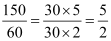
(c) 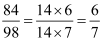
(d) 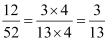
(e) 
Q.8: Ramesh had 20 pencils, Sheelu had 50 pencils and Jamaal had 80 pencils. After 4 months, Ramesh used up 10 pencils, Sheelu used up 25 pencils and Jamaal used up 40 pencils. What fraction did each use up? Check if each has used up an equal fraction of her/his pencils?
Ans :
Fraction
used by Ramesh =
Fraction
used by Sheelu =
Fraction
used by Jamaal =
Yes,
all of them used equal fraction of pencils i.e., .
Q.9: Match the equivalent fractions and write two more for each.
(i)  (a)
(a)  (iv)
(iv)  (d)
(d) 
(ii)  (b)
(b)  (v)
(v)  (e)
(e) 
(iii)  (c)
(c) 
Ans :
(i) 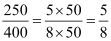
Two
more fractions are  .
.
(ii) 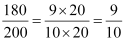
Two
more fractions are  .
.
(iii) 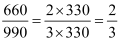
Two
more fractions are  .
.
(iv) 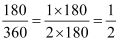
Two
more fractions are  .
.
(v) 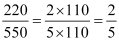
Two
more fractions are  .
.
Now, these can be matched as
(i)  (d),
(ii) (e),
(iii) (a),
(iv) (c),
(v) (b)
(d),
(ii) (e),
(iii) (a),
(iv) (c),
(v) (b)
Exercise 7.4
Q.1: Write shaded portion as fraction. Arrange them in ascending and descending order using correct sign ‘<’, ‘=’, ‘>’ between the fractions:
(a)

(b)

(c)
Show  on
the number line. Put appropriate signs between the fractions given.
on
the number line. Put appropriate signs between the fractions given.
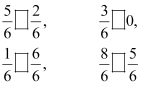
Ans :
(a)

Here,
1st circle represents 3 shaded parts out of 8 equal parts.
Therefore, it represents a fraction  .
.

Here,
2nd circle represents 6 shaded parts out of 8 equal parts. Therefore, it
represents a fraction  .
.

Here,
3rd circle represents 4 shaded parts out of 8 equal parts. Therefore, it
represents a fraction  .
.

Here,
4th circle represents 1 shaded part out of 8 equal parts.
Therefore, it represents a fraction  .
.
Now, these fractions may be arranged as

(b)
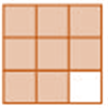
Here,
1st square represents 8 shaded parts out of 9 equal parts.
Therefore, it represents a fraction .
.

Here,
2nd square represents 4 shaded parts out of 9 equal parts. Therefore, it
represents a fraction  .
.

Here,
3rd square represents 3 shaded parts out of 9 equal parts. Therefore, it
represents a fraction  .
.
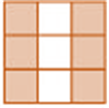
Here,
4th square represents 6 shaded parts out of 9 equal parts. Therefore, it
represents a fraction  .
.
Now, these fractions can be arranged as

(c)
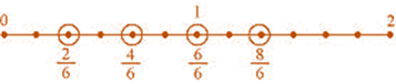
To represent the given fractions  on
number line, each unit length should be divided in 6 equal parts. Now, these
fractions can be represented as
on
number line, each unit length should be divided in 6 equal parts. Now, these
fractions can be represented as
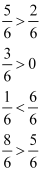
Q.2: Compare the fractions and put an appropriate sign.
(a)  (b)
(b) 
(c)  (d)
(d) 
Ans :
(a) 
Here, the denominators are same. Therefore, the fraction having the greater numerator will be greater.
(b) 

As 4 < 7,

(c) 
Here, the denominators are same. Therefore, the fraction having the greater numerator will be greater.
(d) 
Here, the numerators are same. Therefore, the fraction having lesser denominator will be greater.
Q.3: Make five more such pairs and put appropriate sign.
Ans :
(i) 
Here, the denominators are same. Therefore, the fraction having the greater numerator will be greater.
(ii) 
Here, the denominators are same. Therefore, the fraction having the greater numerator will be greater.
(iii) 
Here, numerators are same. Therefore, the fraction having the lesser denominator will be greater.
(iv) 
Here, the denominators are same. Therefore, the fraction having the greater numerator will be greater.
(v) 
Here, the numerators are same. Therefore, the fraction having the lesser denominator will be greater.
Q.4: Look at the figures and write ‘<’ or ‘>’, ‘=’ between the given pairs of fractions.
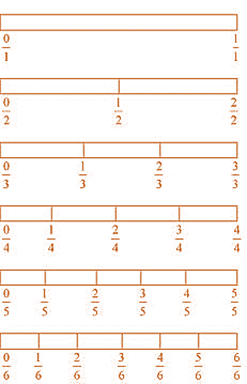
(a) 
(b) 
(c) 
(d) 
(e) 
Ans :
(a) Here, the numerators are same. Therefore, the fraction having the lesser denominator will be greater.
Hence, 
(b) 

As
the denominators of  are
same, the fraction having the greater numerator will be greater.
are
same, the fraction having the greater numerator will be greater.
Hence, 
(c) Here, the numerators are same. Therefore, the fraction having the lesser denominator will be greater.
Hence, 
(d)
As  ,
,

(e) Here, the numerators are same. Therefore, the fraction having the lesser denominator will be greater.
Hence, 
Q.5: How quickly can you do this? Fill appropriate sign (‘<’, ‘=’, ‘>’)
(a)  (b)
(b) 
(c)  (d)
(d) 
(e)  (f)
(f) 
(g)  (h)
(h) 
(i)  (j)
(j)
(k) 
Ans :
(a) Here, the numerators are same. Therefore, the fraction having the lesser denominator will be greater.
Hence, 
(b) 
Hence, 
(c) 

As
the denominators of  are
same, the fraction having the greater numerator will be greater.
are
same, the fraction having the greater numerator will be greater.
Hence, 
(d)
As
the denominators of  are
same, the fraction having the greater numerator will be greater.
are
same, the fraction having the greater numerator will be greater.
Hence, 
(e) Here, the denominators are same. Therefore, the fraction having the greater numerator will be greater.
Hence, 
(f) Here, the denominators are same. Therefore, the fraction having the greater numerator will be greater.
Hence, 
(g)
Hence, 
(h) 
As
the denominators of  are
same, the fraction having the greater numerator will be greater.
are
same, the fraction having the greater numerator will be greater.
Hence, 
(i) 
As
the denominators of  are
same, the fraction having the greater numerator will be greater.
are
same, the fraction having the greater numerator will be greater.
Hence, 
(j)
As
the denominators of are
same, the fraction having the greater numerator will be greater.
Hence,
(k) 
Hence, 
Q.6: The following fractions represent just three different numbers. Separate them into three groups of equivalent fractions, by changing each one to its simplest form.
(a)  (b)
(b) 
(c)  (d)
(d) 
(e)  (f)
(f) 
(g)  (h)
(h) 
(i)  (j)
(j)
(k)  (l)
(l) 
Ans :
(a) 
(b) 
(c) 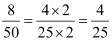
(d) 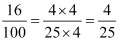
(e) 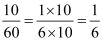
(f) 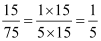
(g) 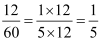
(h) 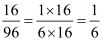
(i) 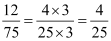
(j) 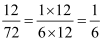
(k) 
(l) 
There are 3 groups of equivalent fractions
 (a), (e), (h), (j), (k)
 (b), (f), (g)
 (c), (d), (i), (l)
Q.7: Find answers to the following. Write and indicate how you solved them.
(a)  ?
(b)
?
(b) 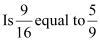 ?
?
(c) 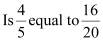 ?
(d)
?
(d) 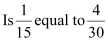 ?
?
Ans :
(a) 
Converting these into like fractions,
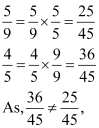
Therefore, 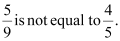
(b) 
Converting these into like fractions,
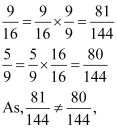
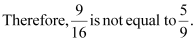
(c) 

Therefore, 
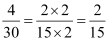
(d) 
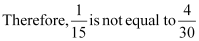
Q.8: Ila read 25 pages of a book containing 100
pages. Lalita read of
the same book. Who read less?
Ans :
Numbers
of pages read by Lalita = =
40
=
40
Number of pages read by Ila = 25
Hence, Ila has read less number of pages.
Q.9: Rafiq exercised for  of
an hour, while Rohit exercised for
of
an hour, while Rohit exercised for  of
an hour.
of
an hour.
Who exercised for a longer time?
Ans :
Rafiq
exercised for  and
Rohit exercised for
and
Rohit exercised for 
Converting these into like fractions,

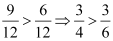
Hence, Rohit exercised for a longer time.
Q.10: In a class A of 25 students, 20 passed in first class; in another class B of 30 students, 24 passed in first class. In which class was a greater fraction of students getting first class?
Ans :
Fraction
of students of class A who passed in Ist class =

Fraction
of students of class B who passed in Ist class =
From both classes, an equal fraction of students passed in first class.
Exercise 7.5
Q.1: Write these fractions appropriately as additions or subtractions:
(a)

(b)

(c)

Ans :
(a) Here, it can be observed that 1st, 2nd, and 3rd rectangles are representing 1, 2, and 3 shaded parts out of 5 equal parts respectively. Clearly, the fraction represented by 3rd rectangle is the sum of the fractions represented by 1st and 2nd rectangles.
Hence, 
(b) Here, it can be observed that 1st, 2nd, and 3rd circles are representing 5, 3, and 2 shaded parts out of 5 equal parts respectively. Clearly, the fraction represented by 3rd circle is the difference between the fractions represented by 1st and 2nd circles.
Hence,
(c) Here, it can be observed that 1st, 2nd, and 3rd rectangles are representing 2, 3, and 5 shaded parts out of 6 equal parts respectively. Clearly, the fraction represented by 3rd rectangle is the sum of the fractions represented by 1st and 2nd rectangles.
Hence, 
Q.2: Solve:
(a)  (b)
(b) 
(c)  (d)
(d) 
(e)  (f)
(f) 
(g)  (h)
(h) 
(i) 
Ans :
(a) 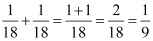
(b) 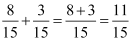
(c) 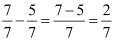
(d) 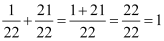
(e) 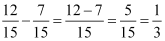
(f) 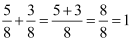
(g) 
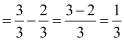
(h) 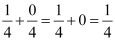
(i) 
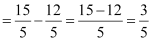
Q.3: Shubham painted of
the wall space in his room. His sister Madhavi helped and painted  of
the wall space. How much did they paint together?
of
the wall space. How much did they paint together?
Ans :
Space
painted by Shubham = of
the room
of
the room
Space
painted by Madhavi = of
the room
of
the room
Hence,
together they painted = of
the room
of
the room
= 1 = the complete wall
Q.4: Fill in the missing fractions.
(a)  (b)
(b) 
(c)  (d)
(d) 
Ans :
(a)
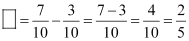
(b)
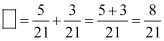
(c)
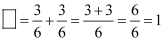
(d)
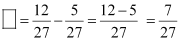
Q.5: Javed was given  of
a basket of oranges. What fraction of oranges was left in the basket?
of
a basket of oranges. What fraction of oranges was left in the basket?
Ans :
Fractions
given to Javed =
Fraction
left in the basket =  =
= 

Exercise 7.6
Q.1: Solve
(a)  (b)
(b) 
(c)  (d)
(d) 
(e)  (f)
(f) 
(g)  (h)
(h) 
(i)  (j)
(j) 
(k)  (l)
(l) 
(m)  (n)
(n) 
Ans :
(a) 
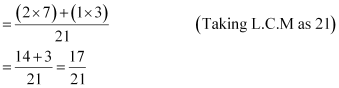
(b) 
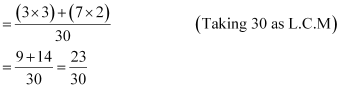
(c) 
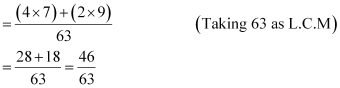
(d) 
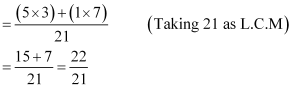
(e) 

(f) 

(g) 
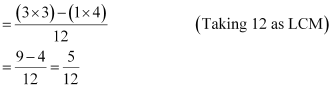
(h) 
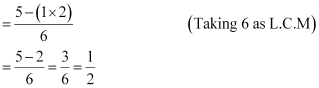
(i) 
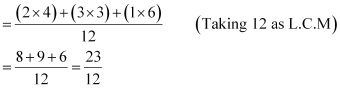
(j) 
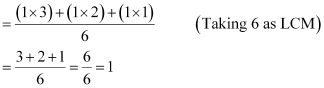
(k) 
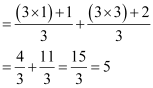
(l) 
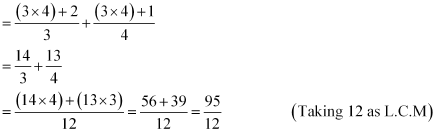
(m) 

(n) 

Q.2: Sarita bought metre
of ribbon and Lalita metre
of ribbon. What is the total length of the ribbon they bought?
Ans :
Length
of ribbon bought by Sarita =
Length
of ribbon bought by Lalita =
Total
length of ribbon bought by them =

Q.3: Naina was given  piece
of cake and Najma was given
piece
of cake and Najma was given  piece
of cake. Find the total amount of cake was given to both of them.
piece
of cake. Find the total amount of cake was given to both of them.
Ans :
Fraction
Naina got =
Fraction
Najma got =
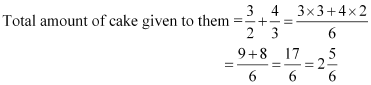
Q.4: Fill in the boxes: (a)  (b)
(b)  (c)
(c) 
Ans :
(a)

(b)

(c)

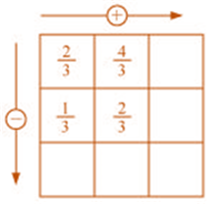
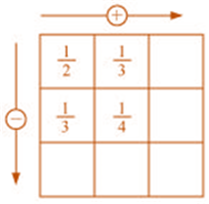
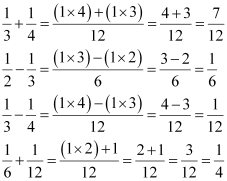
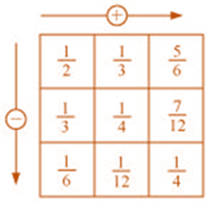
Q.5: Complete the addition-subtraction box.
(a)
(b)
Ans :
(a) 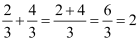
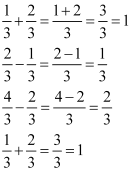
Hence, the given box can be completed as
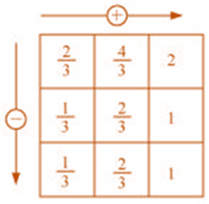
(b) 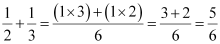
Hence, the given box can be completed as
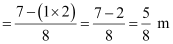
Q.6: A piece of wire  metre
long broke into two pieces. One piece was
metre
long broke into two pieces. One piece was  metre
long. How long is the other piece?
metre
long. How long is the other piece?
Ans :
Length
of one piece =
The length of the other piece of wire will be the difference of the lengths of the original wire and this piece of wire.
Hence,
length of the other piece of wire = 
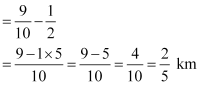
Q.7: Nandini’s house is km
from her school. She walked some distance and then took a bus for km
to reach the school. How far did she walk?
Ans :
Distance walked by Nandini = Total distance − Distance for which she took the bus
Q.8: Asha and Samuel have bookshelves of the same size partly filled with books.
Asha’s shelf is  th
full and Samuel’s shelf is th
full. Whose bookshelf is more full? By what fraction?
th
full and Samuel’s shelf is th
full. Whose bookshelf is more full? By what fraction?
Ans :
Fraction
of Asha’s shelf =
Fraction
of Samuel’s shelf =
Converting these into like fractions,
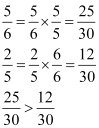
Clearly, Asha’s bookshelf is more full.
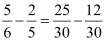
Difference
= 

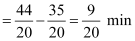
Q.9: Jaidev takes  minutes
to walk across the school ground. Rahul takes
minutes
to walk across the school ground. Rahul takes  minutes
to do the same. Who takes less time and by what fraction?
minutes
to do the same. Who takes less time and by what fraction?
Ans :
Time
taken by Jaidev = minutes
=
minutes
= min
min
Time
taken by Rahul = min
min
Converting these into like fractions,
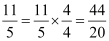
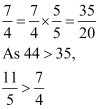
Hence, Rahul takes lesser time.
Difference
= 
Online Tuitions and Self-Study Courses for Grade 6 to 12 & JEE / NEET