
Sometimes, it is very difficult to read, understand and compare very large numbers.
E.g., distance between Sun and Saturn is 1,433,500,000,000 m, distance between Saturn and Uranus is 1,439,000,000,000 m.
To make these numbers easy to read, understand and compare, we use the concept of exponents.
Exponents
The concept of exponent makes the representation of large numbers easier.
Example: let a number 10,000
We can write 10,000 = 10 × 10 × 10 × 10 = 104
Here the notation 104 is the short notation of 10 × 10 × 10 × 10 i.e. 10, 000
So, 104 is the exponential form of 10,000
Here 10 is called the base and 4 the exponent. The number 104 is read as 10 raised to the power of 4 or fourth power of 10.
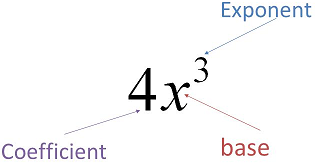
Similarly, 1,000 = 10 × 10 × 10 × 10 = 103
So, 103 is the exponent form of 1,000
Similarly, 1,00,000 = 10 × 10 × 10 × 10 × 10 = 105
105 is the exponential form of 1,00,000
We can use numbers like 10, 100, 100, etc to write the numbers in expanded form.
Example:
12534
= 1 × 10000 + 2 × 1000 + 5 × 100 + 3 × 10 + 4 × 1
= 1 × 10⁴ + 2 × 10³ + 5 × 10² + 3 × 10 + 4
The numbers which have base other than 10 can also be represented in exponent form.
64 = 2 × 2 × 2 × 2 × 2 × 2
= 26
Here, 2 is the base and 6 is the exponent.
Similarly, 125 = 5 × 5 × 5 = 53
81 = 3 × 3 × 3 × 3 = 34
243 = 3 × 3 × 3 × 3 × 3 = 35
We can also write the negative numbers in exponent form.
Example:
−27
= (−3) × (−3) × (−3) = (−3)3
−32
= (−2) ×(−2) × (−2) × (−2) × (−2) = (−2)5
−125
= (−5) × (−5) × (−5) = (−5)3
There are numbers which have more than one base. We can also write these numbers in exponent form.
Example:
36 = 2 × 2 × 3 × 3 = 22 × 33
= 2233
675 = 3 × 3 × 3 × 5 × 5 = 33 × 52
= 3352
1296 = 2 × 2 × 2 × 2 × 3 × 3 × 3 × 3
= 24 × 34
= 2434
Question: Express the following in exponential form:
(i) 6 × 6 × 6 × 6
(ii) t × t
(iii) b × b × b × b
(iv) 5 × 5 × 7 × 7 × 7
(v) 2 × 2 × a × a
(vi) a × a × a × c × c × c × c × d
Solution:
(i) 6 × 6 × 6 × 6
= 64
(ii) t × t
= t2
(iii) b × b × b × b
= b4
(iv) 5 × 5 × 7 × 7 × 7
= 52 × 73
(v) 2 × 2 × a × a
= 22 × a2
(vi) a × a × a × c × c × c × c × d
= a3 × c4 × d
Question: Identify the greater number, wherever possible, in each of the following:
(i) 43 and 34
(ii) 53 or 35
(iii) 28 or 82
(iv) 1002 or 2100
(v) 210 or 102
Solution:
(i) 43 = 4 × 4 × 4 = 64
34 = 3 × 3 × 3 × 3 = 81
Since 64 < 81
So, 34 is greater than 43
(ii) 53 = 5 × 5 × 5 = 125
35 = 3 × 3 × 3 × 3 × 3 = 243
Since 125 < 243
So, 35 is greater than 53
(iii) 28 = 2 × 2 × 2 × 2 × 2 × 2 × 2 × 2 = 256
82 = 8 × 8 = 64
Since, 256 > 64
Thus, 28 is greater than 82
(iv) 1002 = 100 × 100 = 10,000
2100 = 27 × 27 × 286
= 128 × 128 × 286
= 16,384 × 286
Since, 10,000 < 16,384 × 286
Thus, 2100 is greater than 1002.
(v) 210 = 2 × 2 × 2 × 2 × 2 × 2 × 2 × 2 × 2 × 2
= 1,024
102 = 10 × 10 = 100
Since, 1,024 > 100
Thus, 210 is greater than 102
Laws of Exponents
Numbers in exponential form obey certain laws, which are discribed as follows:
(1) Multiplying Powers with the Same Number
For any non−zero integer a, where m and n are whole numbers,
am × an = am + n
Example:
34 × 32 = 34 + 2 = 36
(2) Dividing Powers with the Same Number
For any non−zero integer a, where m and n are whole numbers and m > n,
am / an = am − n
Example:
34 / 32 = 34 − 2 = 32
(3) Taking Power of a Power:
For any non−zero integer a, where m and n are whole numbers,
(am )n = am × n
Example:
(34 )2 = 34 × 2 = 38
(4) Multiplying Powers with the Same Exponents
For any non−zero integer a, where m is any whole numbers,
am × bm = (a × b)m = (ab)m
Example:
23 × 33 = (2 × 3)3 = 63
(5) Dividing Powers with the Same Exponents
For any non−zero integer a and b, where m is any whole numbers,
am / bm = (a / b)m
Example:
23 / 33 = (2/3)3
(6) Any number (except 0) raised to the power 0 is always 1.
a0 = 1 (a ≠ 0)
Example:
30 = 1, (1000)0 = 1, (−5)0 = 1
Question: Simplify
(i) {(25)2 × 73}/(83 × 7)
(ii) (25 × 52 × t8)/(103 × t4)
(iii) (35 × 105 × 25)/(57 × 65)
Solution:
(i) {(25)2 × 73}/(83 × 7)
= (25×2 × 73)/{(23)3 × 7)}
= (210 × 73)/(23×3 × 7)
= (210 × 73)/(29 × 7)
= 210−9 × 73−1
= 2 × 72
= 2 × 49
= 98
(ii) (25 × 52 × t8)/(103 × t4)
=(52 × 52 × t8)/{(5 × 2)3 × t4}
= (52+2 × t8)/(53 × 23 × t4)
= (54 × t8)/(53 × 23 × t4)
= (54−3 × t8−4)/8
= 5t4/8
(iii) (35 × 105 × 25)/(57 × 65)
= {(35 × (2 × 5)5 × 52)}/{57 × (2 × 3)5}
= (35 × 25 × 55+2)/(57 × 25 × 35)
= (35 × 25 × 57)/(57 × 25 × 35)
= 35−5 × 25−5 × 57−7
= 30 × 20 × 50
= 1 × 1 × 1
= 1
Decimal Number System
We can express a large number in terms of 10s.
Example: let a number is 35246
Here, 3 is at ten thousand place, 5 is at thousand place, 2 is at hundred palce, 4 is at 10 tenth place and 6 is at unit place. So, 35246 can be written as
35246
= 3 × 10000 + 5 × 1000 + 2 × 100 + 4 × 10 + 6 × 1
= 3 × 10⁴ + 5 × 10³ + 2 × 10² + 4 × 101 + 6 × 100
Similarly, expansion of 250374 will be as
follows:
250374
= 2 × 100000 + 5 × 10000 + 0 × 1000 + 3 × 100 + 7 × 10 + 4 × 1
= 2 × 10⁵ + 5 × 10⁴ + 0 × 103 + 3 × 10² + 7 × 101 + 4 × 100
= 2 × 10⁵ + 5 × 10⁴ + 3 × 10² + 7 × 101 + 4 × 100
Question: Write the following numbers in the expanded form:
279404, 3006194, 2806196, 120719, 20068
Solution:
(i) 2,79,404
= 2,00,000 + 70,000 + 9,000 + 400 + 00 + 4
= 2 × 100000 + 7 × 10000 + 9 × 1000 + 4 × 100 + 0 × 10 + 4 × 1
= 2 × 10⁵ + 7 × 10⁴ + 9 × 10³ + 4 × 10² + 0 × 101 + 4 × 100
(ii) 30,06,194
= 30,00,000 + 0 + 0 + 6,000 + 100 + 90 + 4
= 3 × 1000000 + 0 × 100000 + 0 × 10000 + 6 × 1000 + 1 × 100 + 9 × 101 + 4 × 1
= 3 × 10⁶ + 0 × 105 + 0 × 104 + 6 × 10³ + 1 × 10² + 9 × 101 + 4 × 100
(iii) 28,06,196
= 20,00,000 + 8,00,000 + 0 + 6,000 + 100 + 90 + 6
= 2 × 1000000 + 8 × 100000 + 0 × 10000 + 6 × 1000 + 1 × 100 + 9 × 10 + 6 × 1
= 2 × 10⁶ + 8 × 10⁵ + 0 × 104 + 6 × 10³ + 1 × 10² + 9 × 101 + 6 × 100
(iv) 1,20,719
= 1,00,000 + 20,000 + 0 + 700 + 10 + 9
= 1 × 100000 + 2 × 10000 + 0 × 1000 + 7 × 100 + 1 × 10 + 9 × 1
= 1 × 10⁵ + 2 × 10⁴ + 0 × 103 + 7 × 10² + 1 × 101 + 9 × 100
(v) 20,068
= 20,000 + 00 + 00 + 60 + 8
= 2 × 10000 + 0 × 1000 + 0 × 100 + 6 × 10 + 8 × 1
= 2 × 10⁴ + 0 × 103 + 0 × 102 + 6 × 101 + 8 × 100
Expressing Large Number in The Standard Form
We know that reading, writing and understanding a large number is not convenient. So, to make it convenient, we use the concept of powers.
Any number can be expressed as a decimal number between 1.0 and 10.0 including 1.0 multiplied by a power of 10. Such a form of a number is called its standard form.
Example: Let a number be 3500
We can express this number in many ways using exponent.
3500 = 35 × 100 = 35 × 102
3500 = 350 × 10 = 350 × 101
3500 = 3.5 × 1000 = 3.5 × 10³
3500 = 0.35 × 10000 = 3.5 × 10⁴
All of these are the representation of the number 3500 in exponent form. But the standard form of the number 3500 is that number which is expressed as number between 1 and 10.
So, 3500 = 3.5 × 1000 = 3.5 × 10³ is the standard form of the number 3500
Similarly, 12756000
= 12756 × 1000
= 1.2756 × 1000 × 10000
= 1.2756 × 10⁷
Question: Express the following numbers in standard form:
(i) 5,00,00,000
(ii) 70,00,000
(iii) 3,18,65,00,000
(iv) 3,90,878
(v) 39087.8
(vi) 3908.78
Solution:
(i) 5,00,00,000
= 5 × 1,00,00,000
= 5 × 10⁷
(ii) 70,00,000
= 7 × 10,00,000
= 7 × 10⁶
(iii) 3,18,65,00,000
= 31865 × 100000
= 3.1865 × 10000 × 100000
= 3.1865 × 10⁹
(iv) 3,90,878
= 3.90878 × 100000
= 3.90878 × 10⁵
(v) 39087.8
= 3.90878 × 10000
= 3.90878 × 10⁴
(vi) 3908.78
= 3.90878 × 1000
= 3.90878 × 10³
Online Tuitions and Self-Study Courses for Grade 6 to 12 & JEE / NEET