
Conversion of Units
Sometimes we need to convert the unit of the given measurements to make it similar to the other given units.
|
Unit |
Conversion |
|
1 cm |
10 mm |
|
1 m |
100 cm |
|
1 km |
1000 m |
|
1 hectare(ha) |
100 × 100 m |
|
1 cm2 |
100 mm2 |
|
1 m2 |
10000 cm2 |
|
1 km2 |
1000000 m2 |
|
1 ha |
10000 m2 |
Question: Convert 38 cm2 in mm2
Solution:
1 cm = 10 mm
1 cm2 = 1 cm × 1 cm
=10 mm × 10 mm
1 cm2 = 100 mm2
38 cm2 = 38 × 100 mm2 = 3800 mm2
Question: Convert 9.1 ha in m2
Solution:
1 ha = 10000 m2
9.1 ha = 9.1 × 10000 m2
= 91000 m2
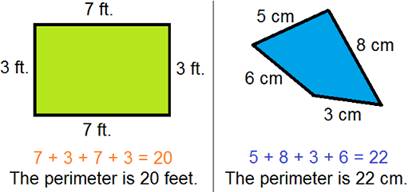
Perimeter
Perimeter is the length of the outline, i.e., boundary of a closed figure.
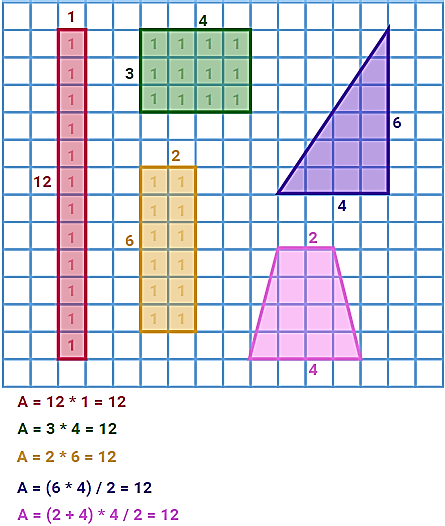
Area
Area is the amount of surface of a closed figure.
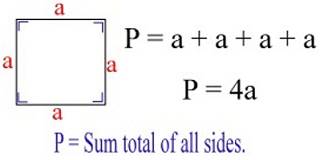
Perimeter of Square
Perimeter of square = 4 × Side
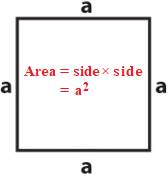
Area of Square
Area of square = Side × Side
Question: Find the area and perimeter of a square-shaped cardboard whose length is 7 cm.
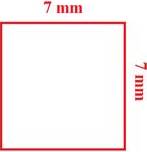
Solution:
Area of square = (side)2
= (7)2
= 49 cm2
Perimeter of square = 4 × side
= 4 × 7
= 28 cm
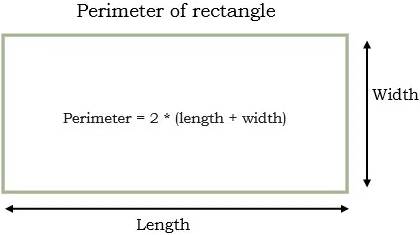
Perimeter of Rectangle
Perimeter of rectangle = 2(Length + Breadth)
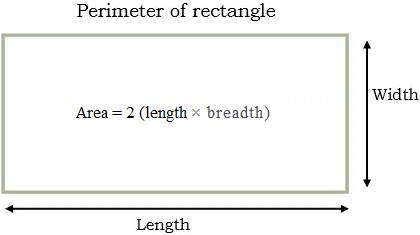
Area of Rectangle
Area of rectangle = Length × Breadth
Question: What is the length of a rectangular field if its width is 80 ft and Area is 2400 ft2?
Solution:
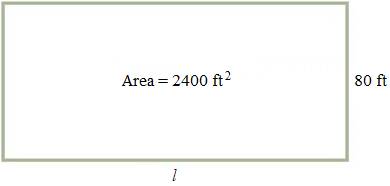
Area of rectangular field = length × width
2400 = l × 80
l = 2400/80
l = 30 ft
Perimeter of a regular polygon = Number of sides × length of one side
Triangles as Parts of Rectangles
Diagonal of a rectangle divides itself in two equal triangles.
Hence, the area of these triangles = half of the area of a rectangle.
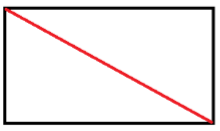
The area of each triangle = 1/2 (Area of the rectangle)
Similarly, two diagonals of a square divide itself in four equal triangles.
Hence, the area of each triangle = one-fourth of the area of the square.
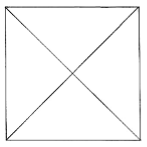
The area of each triangle = 1/4 (Area of the square)
Question: What will be the area of each triangle if we draw two diagonals of a square with side 12 cm?
Solution:
Area of square = 12 × 12
= 144 cm2
The area of each triangle = 1/4 (Area of the square)
= 1/4 × 144
= 36 cm2
Congruent Parts of Rectangles
Two parts of a rectangle (made by a straight line) are congruent to each other if the area of the first part is equal to the area of the second part.
The area of each congruent part = 1/2 (Area of the rectangle)
Question: Find the area of each part of the given rectangle.
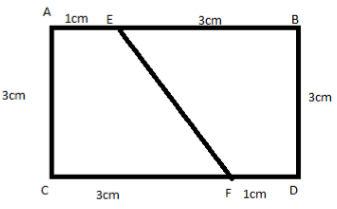
Solution:
The area of each congruent part = 1/2 (Area of the rectangle)
= 1/2 (l × b) cm2
=1/2 (4 × 3) cm2
= 1/2 (12) cm2
= 6 cm2
Area of Parallelogram
Area of parallelogram = base × height
Or b × h or (bh)
Any side of the parallelogram can be considered as the base.
The perpendicular drawn on that side from the opposite vertex is the height of the parallelogram.
Question: Find the area of the figure given below:
(all measures in cm)
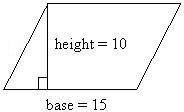
Solution:
Base of ∥ gm = 15 cm
Height of ∥ gm = 10 cm
Area of ∥ gm = b × h
= 15 × 10
= 150 cm2
Area of Triangle
If we join two congruent triangles together then we get a parallelogram.
Hence, the area of the triangle = half of the area of the parallelogram.
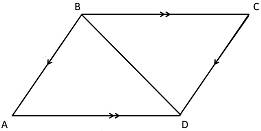
Area of Triangle = 1/2 (Area of ∥ gm)
= 1/2 (base × height)
Question: Find the area of the figure given below:
(All measures in cm)
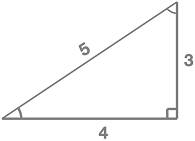
Solution:
Area of triangle = 1/2 (base × height)
= 1/2 (4 × 3)
= 1/2 × 12
= 6 cm2
Circumference of a Circle
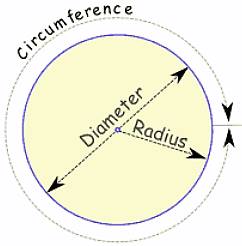
The circumference of a circle refers to the distance around the circle. It is perimeter of the circle.
Radius of the circle: A straight line from any point on the circumference to the centre of the circle.
Diameter of the circle: A straight line passing through centre of the circle, from one point on the circumference to the other point on the circumference.
diameter (d) = twice the radius (r)
d = 2r
π (pi): It is the ratio of the circumference to the diameter of a circle.
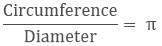
Circumference(c) = π × diameter
C = πd
= π × 2r
C = 2πr
Question: What is the circumference of a circle of diameter 18 cm (Take π = 3.14)?
Solution:
C = πd
C = 3.14 × 18
= 56.52 cm
Area of Circle
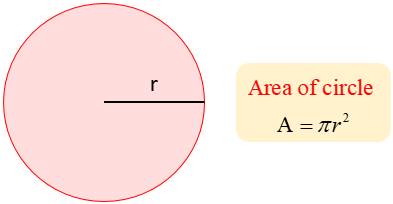
Area of the circle = (Half of the circumference) × radius
= πr2
Question: Find the area of a circle of radius 17 cm (use π = 3.14).
Solution:
r = 17 cm
π = 3.14
Area of circle = 3.14 × 172
= 907.46 cm2
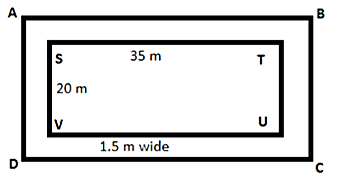
Question: A rectangular park is 35 m long and 20 m wide. A path 1.5 m wide is constructed outside the park. Find the area of the path.
Solution:
Area of the path
= Area of rectangle ABCD – Area of rectangle STUV
AB = 35 + 2.5 + 2.5
= 40 m
AD = 20 + 2.5 + 2.5
= 25 m
Area of ABCD = 40 × 25
= 1000 m2
Area of STUV = 35 × 20
= 700 m2
Area of path = Area of rectangle ABCD – Area of rectangle STUV
= 1000 – 700
= 300 m2
Online Tuitions and Self-Study Courses for Grade 6 to 12 & JEE / NEET