
Class 6 Maths NCERT Solutions
Chapter 3 Playing with Numbers
Exercise 3.1
Q.1: Write all the factors of the following
numbers:
(a) 24 (b)
15
(c) 21 (d)
27
(e) 12 (f)
20
(g) 18 (h)
23
(i) 36
Ans :
(a) 24
24 = 1 × 24 24 = 2 × 12 24 = 3 × 8
24 = 4 × 6 24 = 6 × 4
Hence, factors of 24 are 1, 2, 3, 4, 6, 8, 12,
and 24
(b) 15
15 = 1 × 15 15 = 3 × 5 15 = 5 × 3
Hence, factors
of 15 are 1, 3, 5, and 15
(c) 21
21 = 1 × 21 21 = 3 × 7 21 = 7 × 3
Hence, factors of 21 are 1, 3, 7, and 21
(d) 27
27 = 1 × 27 27 = 3 × 9 27 = 9 × 3
Hence, factors of 27 are 1, 3, 9, and 27
(e) 12
12 = 1 × 12 12 = 2 × 6 12 = 3 × 4 12 = 4 × 3
Hence, factors of 12 are 1, 2, 3, 4, 6, and 12
(f) 20
20 = 1 × 20 20 = 2 × 10 20 = 4 × 5 20 = 5 × 4
Hence, factors of 20 are 1, 2, 4, 5, 10, and
20
(g) 18
18 = 1 × 18 18 = 2 × 9 18 = 3 × 6 18 = 6 × 3
Hence, factors of 18 are 1, 2, 3, 6, 9, and 18
(h) 23
23 = 1 × 23 23 = 23 × 1
Hence, factors of 23 are 1 and 23
(i) 36
36 = 1 × 36 36 = 2 × 18 36 = 3 × 12 36 = 4 × 9
36 = 6 × 6
Hence, factors of 36 are 1, 2, 3, 4, 6, 9, 12,
18, and 36
Q.2: Write first five multiplies of:
(a) 5 (b)
8 (c) 9
Ans :
(a) 5 × 1 = 5
5 × 2 = 10
5 × 3 = 15
5 × 4 = 20
5 × 5 = 25
Hence, the required multiples are 5, 10, 15,
20, and 25.
(b) 8 × 1 = 8
8 × 2 = 16
8 × 3 = 24
8 × 4 = 32
8 × 5 = 40
Hence, the required multiples are 8, 16, 24,
32, and 40.
(c) 9 × 1 = 9
9 × 2 = 18
9 × 3 = 27
9 × 4 = 36
9 × 5 = 45
Hence, the required multiples are 9, 18, 27,
36, and 45.
Q.3: Match the items in column 1 with the
items in column 2.
|
Column 1 |
Column 2 |
|
(i) 35 |
(a) Multiple of 8 |
|
(ii) 15 |
(b) Multiple of 7 |
|
(iii) 16 |
(c) Multiple of 70 |
|
(iv) 20 |
(d) Factor of 30 |
|
(v) 25 |
(e) Factor of 50 |
|
- |
(f) Factor of 20 |
Ans :
|
Column 1 |
Column 2 |
|
(i) 35 |
(b) Multiple of 7 |
|
(ii) 15 |
(d) Factor of 30 |
|
(iii) 16 |
(a) Multiple of 8 |
|
(iv) 20 |
(f) Factor of 20 |
|
(v) 25 |
(e) Factor of 50 |
Q.4: Find all the multiples of 9 up to 100.
Ans :
9 × 1 = 9
9 × 2 = 18
9 × 3 = 27
9 × 4 = 36
9 × 5 = 45
9 × 6 = 54
9 × 7 = 63
9 × 8 = 72
9 × 9 = 81
9 × 10 = 90
9 × 11 = 99
Therefore, the multiples of 9 up to 100
are
9, 18, 27, 36, 45, 54, 63, 72, 81, 90,
and 99
Exercise 3.2
Q.1: What is the sum of any two (a) Odd numbers?
(b) Even numbers?
Ans :
(a) The sum of two odd numbers is even.
e.g., 1 + 3 = 4
13 + 19 = 32
(b) The sum of two even numbers is even.
e.g., 2 + 4 = 6
10 + 18 = 28
Q.2: State whether the following statements
are True or False:
(a) The sum of three odd numbers is
even.
(b) The sum of two odd numbers and one
even number is even.
(c) The product of three odd numbers is
odd.
(d) If an even number is divided by 2,
the quotient is always odd.
(e) All prime numbers are odd.
(f) Prime numbers do not have any
factors.
(g) Sum of two prime numbers is always
even.
(h) 2 is the only even prime number.
(i) All even numbers are composite
numbers.
(j) The product of two even numbers is always even.
Ans :
(a) False 3 + 5 + 7 = 15, i.e., odd
(b) True 3 + 5 + 6 = 14, i.e., even
(c) True 3 × 5 × 7 = 105, i.e., odd
(d) False 4 ÷ 2 = 2, i.e., even
(e) False 2 is a prime number and it is
also even
(f) False 1 and the number itself are
factors of the number
(g) False 2 + 3 = 5, i.e., odd
(h) True
(i) False 2 is a prime number
(j) True 2 × 4 = 8, i.e., even
Q.3: The numbers 13 and 31 are prime
numbers. Both these numbers have same digits 1 and 3. Find such pairs of prime
numbers up to 100.
Ans :
17, 71
37, 73
79, 97
Q.4: Write down separately the prime and composite
numbers less than 20.
Ans :
Prime numbers less than 20 are
2, 3, 5, 7, 11, 13, 17, 19
Composite numbers less than 20 are
4, 6, 8, 9, 10, 12, 14, 15, 16, 18
Q.5: What is the greatest prime number
between 1 and 10?
Ans :
Prime numbers between 1 and 10 are 2,
3, 5, and 7. Among these numbers, 7 is the greatest.
Q.6: Express the following as the sum of two
odd primes.
(a) 44 (b)
36
(c) 24 (d)
18
Ans :
(a) 44 = 37 + 7
(b) 36 = 31 + 5
(c) 24 = 19 + 5
(d) 18 = 11 + 7
Q.7: Give three pairs of prime numbers whose
difference is 2.
[Remark: Two prime numbers whose difference is 2
are called twin primes].
Ans :
3, 5
41, 43
71, 73
Q.8: Which of the following numbers are
prime?
(a) 23 (b)
51
(c) 37 (d)
26
Ans :
(a) 23
23 = 1 × 23
23
has only two factors, 1 and 23. Therefore, it is a prime number.
(b) 51
51 = 1 × 51
51 = 3 × 17
51 has four factors, 1, 3, 17, 51. Therefore, it is
not a prime number. It is a composite number.
(c) 37 = 1 × 37
It has only two factors, 1 and 37. Therefore, it is
a prime number.
(d) 26 = 1 × 26
26 = 2 × 13
26 has four factors (1, 2, 13, 26). Therefore, it
is not a prime number. It is a composite number.
Q.9: Write seven consecutive composite
numbers less than 100 so that there is no prime number between them.
Ans :
Between 89 and 97, both of which are
prime numbers, there are 7 composite numbers. They are
90, 91, 92, 93, 94, 95, 96
Numbers Factors
90 1, 2, 3, 5, 6, 9, 10, 15, 18, 30, 45, 90
91 1, 7, 13, 91
92 1, 2, 4, 23, 46, 92
93 1, 3, 31, 93
94 1, 2, 47, 94
95 1, 5, 19, 95
96 1, 2, 3, 4, 6, 8, 12, 16, 24, 32, 48, 96
Q.10: Express each of the following numbers
as the sum of three odd primes:
(a) 21 (b)
31
(c) 53 (d)
61
Ans :
(a) 21 = 3 + 7 + 11
(b) 31 = 5 + 7 + 19
(c) 53 = 3 + 19 + 31
(d) 61 = 11 + 19 + 31
Q.11: Write five pairs of prime numbers less
than 20 whose sum is divisible by 5.
(Hint: 3 + 7 = 10)
Ans :
2 + 3 = 5
2 + 13 = 15
3 + 17 = 20
7 + 13 = 20
19 + 11 = 30
Q.12: Fill in the blanks:
(a) A number which has only two factors
is called a _______.
(b) A number which has more than two
factors is called a _______.
(c) 1 is neither _______ nor _______.
(d) The smallest prime number is
_______.
(e) The smallest composite number is
_______.
(f) The smallest even number is _______.
Ans :
(a) Prime number
(b) Composite number
(c) Prime number, composite number
(d) 2
(e) 4
(f) 2
Exercise 3.3
Q.1: Using divisibility tests, determine
which of the following numbers are divisible by 2; by 3; by 4; by 5; by 6; by
8; by 9; by 10; by 11 (say, yes or no):
|
Number |
Divisible
by |
||||||||
|
2 |
3 |
4 |
5 |
6 |
8 |
9 |
10 |
11 |
|
|
128 |
Yes |
No |
Yes |
No |
No |
Yes |
No |
No |
No |
|
990 |
… |
… |
… |
… |
… |
… |
… |
… |
… |
|
1586 |
… |
… |
… |
… |
… |
… |
… |
… |
… |
|
275 |
… |
… |
… |
… |
… |
… |
… |
… |
… |
|
6686 |
… |
… |
… |
… |
… |
… |
… |
… |
… |
|
639210 |
… |
… |
… |
… |
… |
… |
… |
… |
… |
|
429714 |
… |
… |
… |
… |
… |
… |
… |
… |
… |
|
2856 |
… |
… |
… |
… |
… |
… |
… |
… |
… |
|
3060 |
… |
… |
… |
… |
… |
… |
… |
… |
… |
|
406839 |
… |
… |
… |
… |
… |
… |
… |
… |
… |
Ans :
|
Numbers |
2 |
3 |
4 |
5 |
6 |
8 |
9 |
10 |
11 |
|
990 |
Yes |
Yes |
No |
Yes |
Yes |
No |
Yes |
Yes |
Yes |
|
1586 |
Yes |
No |
No |
No |
No |
No |
No |
No |
No |
|
275 |
No |
No |
No |
Yes |
No |
No |
No |
No |
Yes |
|
6686 |
Yes |
No |
No |
No |
No |
No |
No |
No |
No |
|
639210 |
Yes |
Yes |
No |
Yes |
Yes |
No |
No |
Yes |
Yes |
|
429714 |
Yes |
Yes |
No |
No |
Yes |
No |
Yes |
No |
No |
|
2856 |
Yes |
Yes |
Yes |
No |
Yes |
Yes |
No |
No |
No |
|
3060 |
Yes |
Yes |
Yes |
Yes |
Yes |
No |
Yes |
Yes |
No |
|
406839 |
No |
Yes |
No |
No |
No |
No |
No |
No |
No |
Q.2: Using divisibility tests, determine
which of the following numbers are divisible by 4; by 8:
(a) 572 (b) 726352
(c) 5500 (d) 6000
(e) 12159 (f) 14560
(g) 21084 (h) 31795072
(i) 1700 (j) 2150
Ans :
(a) 572
The last two digits are 72. Since 72 is divisible
by 4, the given number is also divisible by 4.
The last three digits are 572. Since 572 is not
divisible by 8, the given number is also not divisible by 8.
(b) 726352
The last two digits are 52. As 52 is divisible by
4, the given number is also divisible by 4.
The last three digits are 352. Since 352 is
divisible by 8, the given number is also divisible by 8.
(c) 5500
Since last two digits are 00, it is divisible by 4.
The last 3 digits are 500. Since 500 is not
divisible by 8, the given number is also not divisible by 8.
(d) 6000
Since the last 2 digits are 00, the given number is
divisible by 4.
Since the last 3 digits are 000, the given number
is divisible by 8.
(e) 12159
The last 2 digits are 59. Since 59 is not divisible
by 4, the given number is also not divisible by 4.
The last 3 digits are 159. Since 159 is not
divisible by 8, the given number is not divisible by 8.
(f) 14560
The last two digits are 60. Since 60 is divisible
by 4, the given number is divisible by 4.
The last 3 digits are 560. Since 560 is divisible
by 8, the given number is divisible by 8.
(g) 21084
The last two digits are 84. Since 84 is divisible
by 4, the given number is divisible by 4.
The last three digits are 084. Since 084 is not
divisible by 8, the given number is not divisible by 8.
(h) 31795072
The last two digits are 72. Since 72 is divisible
by 4, the given number is divisible by 4.
The last three digits are 072. Since 072 is
divisible by 8, the given number is divisible by 8.
(i) 1700
The last two digits are 00. Since 00 is divisible
by 4, the given number is divisible by 4.
The last three digits are 700. Since 700 is not
divisible by 8, the given number is not divisible by 8.
(j) 2150
The last two digits are 50. Since 50 is not
divisible by 4, the given number is not divisible by 4.
The last three digits are 150. Since 150 is not
divisible by 8, the given number is not divisible by 8.
Q.3: Using divisibility tests, determine
which of following numbers are divisible by 6:
(a) 297144 (b) 1258
(c) 4335 (d) 61233
(e) 901352 (f) 438750
(g) 1790184 (h) 12583
(i) 639210 (j) 17852
Ans :
(a) 297144
Since the last digit of the number is 4, it is
divisible by 2.
On adding all the digits of the number, the sum
obtained is 27. Since 27 is divisible by 3, the given number is also divisible
by 3.
As the number is divisible by both 2 and 3, it is
divisible by 6.
(b) 1258
Since the last digit of the number is 8, it is
divisible by 2.
On adding all the digits of the number, the sum
obtained is 16. Since 16 is not divisible by 3, the given number is also not
divisible by 3.
As the number is not divisible by both 2 and 3, it
is not divisible by 6.
(c) 4335
The last digit of the number is 5, which is not
divisible by 2. Therefore, the given number is also not divisible by 2.
On adding all the digits of the number, the sum
obtained is 15. Since 15 is divisible by 3, the given number is also divisible
by 3.
As the number is not divisible by both 2 and 3, it
is not divisible by 6.
(d) 61233
The last digit of the number is 3, which is not divisible
by 2. Therefore, the given number is also not divisible by 2.
On adding all the digits of the number, the sum
obtained is 15. Since 15 is divisible by 3, the given number is also divisible
by 3.
As the number is not divisible by both 2 and 3, it is
not divisible by 6.
(e) 901352
Since the last digit of the number is 2, it is
divisible by 2.
On adding all the digits of the number, the sum
obtained is 20. Since 20 is not divisible by 3, the given number is also not
divisible by 3.
As the number is not divisible by both 2 and 3, it
is not divisible by 6.
(f) 438750
Since the last digit of the number is 0, it is
divisible by 2.
On adding all the digits of the number, the sum
obtained is 27. Since 27 is divisible by 3, the given number is also divisible
by 3.
As the number is divisible by both 2 and 3, it is
divisible by 6.
(g) 1790184
Since the last digit of the number is 4, it is
divisible by 2.
On adding all the digits of the number, the sum
obtained is 30. Since 30 is divisible by 3, the given number is also divisible
by 3.
As the number is divisible by both 2 and 3, it is
divisible by 6.
(h) 12583
Since the last digit of the number is 3, it is not
divisible by 2.
On adding all the digits of the number, the sum
obtained is 19. Since 19 is not divisible by 3, the given number is also not
divisible by 3.
As the number is not divisible by both 2 and 3, it
is not divisible by 6.
(i) 639210
Since the last digit of the number is 0, it is
divisible by 2.
On adding all the digits of the number, the sum
obtained is 21. Since 21 is divisible by 3, the given number is also divisible
by 3.
As the number is divisible by both 2 and 3, it is
divisible by 6.
(j) 17852
Since the last digit of the number is 2, it is
divisible by 2.
On adding all the digits of the number, the sum
obtained is 23. Since 23 is not divisible by 3, the given number is also not
divisible by 3.
As the number is not divisible by both 2 and 3, it
is not divisible by 6.
Q.4: Using divisibility tests, determine
which of the following numbers are divisible by 11:
(a) 5445 (b) 10824
(c) 7138965 (d) 70169308
(e) 10000001 (f) 901153
Ans :
(a) 5445
Sum of the digits at odd places = 5 + 4 = 9
Sum of the digits at even places = 4 + 5 = 9
Difference = 9 − 9 = 0
As the difference between the sum of the digits at
odd places and the sum of the digits at even places is 0, therefore, 5445 is
divisible by 11.
(b) 10824
Sum of the digits at odd places = 4 + 8 + 1 = 13
Sum of the digits at even places = 2 + 0 = 2
Difference = 13 − 2 = 11
The difference between the sum of the digits at odd
places and the sum of the digits at even places is 11, which is divisible by
11. Therefore, 10824 is divisible by 11.
(c) 7138965
Sum of the digits at odd places = 5 + 9 + 3 + 7 =
24
Sum of the digits at even places = 6 + 8 + 1 = 15
Difference = 24 − 15 = 9
The difference between the sum of the digits at odd
places and the sum of digits at even places is 9, which is not divisible by 11.
Therefore, 7138965 is not divisible by 11.
(d) 70169308
Sum of the digits at odd places = 8 + 3 + 6 + 0 =
17
Sum of the digits at even places = 0 + 9 + 1 + 7 =
17
Difference = 17 − 17 = 0
As the difference between the sum of the digits at
odd places and the sum of the digits at even places is 0, therefore, 70169308
is divisible by 11.
(e) 10000001
Sum of the digits at odd places = 1
Sum of the digits at even places = 1
Difference = 1 − 1 = 0
As the difference between the sum of the digits at
odd places and the sum of the digits at even places is 0, therefore, 10000001
is divisible by 11.
(f) 901153
Sum of the digits at odd places = 3 + 1 + 0 = 4
Sum of the digits at even places = 5 + 1 + 9 = 15
Difference = 15 − 4 = 11
The difference between the sum of the digits at odd
places and the sum of the digits at even places is 11, which is divisible by
11. Therefore, 901153 is divisible by 11.
Q.5: Write the smallest digit and the
greatest digit in the blank space of each of the following numbers so that the
number formed is divisible by 3:
(a) _6724
(b) 4765_2
Ans :
(a) _6724
Sum of the remaining digits = 19
To make the number divisible by 3, the sum of its
digits should be divisible by 3.
The smallest multiple of 3 which comes after 19 is
21.
Therefore, smallest number = 21 − 19 = 2
Now, 2 + 3 + 3 = 8
However, 2 + 3 + 3 + 3 = 11
If we put 8, then the sum of the digits will be 27
and as 27 is divisible by 3, the number will also be divisible by 3.
Therefore, the largest number is 8.
(b) 4765_2
Sum of the remaining digits = 24
To make the number divisible by 3, the sum of its
digits should be divisible by 3. As 24 is already divisible by 3, the smallest
number that can be placed here is 0.
Now, 0 + 3 = 3
3 + 3 = 6
3 + 3 + 3 = 9
However, 3 + 3 + 3 + 3 = 12
If we put 9, then the sum of the digits will be 33
and as 33 is divisible by 3, the number will also be divisible by 3.
Therefore, the largest number is 9.
Q.6: Write a digit in the blank space of
each of the following numbers so that the number formed is divisible by 11:
(a) 92_389
(b) 8_9484
Ans :
(a) 92_389
Let a be placed in the blank.
Sum of the digits at odd places = 9 + 3 + 2 = 14
Sum of the digits at even places = 8 + a +
9 = 17 + a
Difference = 17 + a − 14 = 3
+ a
For a number to be divisible by 11, this difference
should be zero or a multiple of 11.
If 3 + a = 0, then
a = − 3
However, it cannot be negative.
A closest multiple of 11, which is near to 3, has
to be taken. It is 11itself.
3 + a = 11
a = 8
Therefore, the required digit is 8.
(b) 8_9484
Let a be placed in the blank.
Sum of the digits at odd places = 4 + 4 + a =
8 + a
Sum of the digits at even places = 8 + 9 + 8 = 25
Difference = 25 − (8 + a)
= 17 − a
For a number to be divisible by 11, this difference
should be zero or a multiple of 11.
If 17 − a = 0, then
a = 17
This is not possible.
A multiple of 11 has to be taken. Taking 11, we
obtain
17 − a = 11
a = 6
Therefore, the required digit is 6.
Exercise 3.4
Q.1: Find the common factors of:
(a) 20 and 28
(b) 15 and 25
(c) 35 and 50
(d) 56 and 120
Ans :
(a) Factors of 20 = 1, 2, 4, 5, 10, 20
Factors of 28 = 1, 2, 4, 7, 14, 28
Common factors = 1, 2, 4
(b) Factors of 15 = 1, 3, 5, 15
Factors of 25 = 1, 5, 25
Common factors = 1, 5
(c) Factors of 35 = 1, 5, 7, 35
Factors of 50 = 1, 2, 5, 10, 25, 50
Common factors = 1, 5
(d) Factors of 56 = 1, 2, 4, 7, 8, 14,
28, 56
Factors of 120 = 1, 2, 3, 4, 5, 6, 8, 10, 12, 15,
20, 24, 30, 40, 60, 120
Common factors = 1, 2, 4, 8
Q.2: Find the common factors of:
(a) 4, 8 and 12
(b) 5, 15 and 25
Ans :
(a) 4, 8, 12
Factors of 4 = 1, 2, 4
Factors of 8 = 1, 2, 4, 8
Factors of 12 = 1, 2, 3, 4, 6, 12
Common factors = 1, 2, 4
(b) 5, 15, and 25
Factors of 5 = 1, 5
Factors of 15 = 1, 3, 5, 15
Factors of 25 = 1, 5, 25
Common factors = 1, 5
Q.3: Find first three common multiples of:
(a) 6 and 8
(b) 12 and 18
Ans :
(a) 6 and 8
Multiple of 6 = 6, 12, 18, 24, 30…..
Multiple of 8 = 8, 16, 24, 32……
3 common multiples = 24, 48, 72
(b) 12 and 18
Multiples of 12 = 12, 24, 36, 48
Multiples of 18 = 18, 36, 54, 72
3 common multiples = 36, 72, 108
Q.4: Write all the numbers less than 100
which are common multiples of 3 and 4.
Ans :
Multiples of 3 = 3, 6, 9, 12, 15…
Multiples of 4 = 4, 8, 12, 16, 20…
Common multiples = 12, 24, 36, 48, 60, 72, 84, 96
Q.5: Which of the following numbers are
co-prime?
(a) 18 and 35
(b) 15 and 37
(c) 30 and 415
(d) 17 and 68
(e) 216 and 215
(f) 81 and 16
Ans :
(a) Factors of 18 = 1, 2, 3, 6, 9, 18
Factors of 35 = 1, 5, 7, 35
Common factor = 1
Therefore, the given two numbers are co-prime.
(b) Factors of 15 = 1, 3, 5, 15
Factors of 37 = 1, 37
Common factors = 1
Therefore, the given two numbers are co-prime.
(c) Factors of 30 = 1, 2, 3, 5, 6, 10,
15, 30
Factors of 415 = 1, 5, 83, 415
Common factors = 1, 5
As these numbers have a common factor other than 1,
the given two numbers are not co-prime.
(d) Factors of 17 = 1, 17
Factors of 68 = 1, 2, 4, 17, 34, 68
Common factors = 1, 17
As these numbers have a common factor other than 1,
the given two numbers are not co-prime.
(e) 216 and 215
Factors of 216 = 1, 2, 3, 4, 6, 8, 9, 12, 18, 24,
27, 36, 54, 72, 108, 216
Factors of 215 = 1, 5, 43, 215
Common factors = 1
Therefore, the given two numbers are co-prime.
(f) 81 and 16
Factors of 81 = 1, 3, 9, 27, 81
Factors of 16 = 1, 2, 4, 8, 16
Common factors = 1
Therefore, the given two numbers are co- prime.
Q.6: A number is divisible by both 5 and 12.
By which other number will that number be always divisible?
Ans :
Factors of 5 = 1, 5
Factors of 12 = 1, 2, 3, 4, 6, 12
As the common factor of these numbers
is 1, the given two numbers are co- prime and the number will also be divisible
by their product, i.e. 60, and the factors of 60, i.e., 1, 2, 3, 4, 5, 6, 10,
12, 15, 20, 30, 60.
Q.7: A number is divisible by 12. By what
other number will that number be divisible?
Ans :
Since the number is divisible by 12, it
will also be divisible by its factors i.e., 1, 2, 3, 4, 6, 12. Clearly, 1, 2,
3, 4, and 6 are numbers other than 12 by which this number is also divisible.
Exercise 3.5
Q.1: Which of the following statements are
true?
(a) If a number is divisible by 3, it
must be divisible by 9.
(b) If a number is divisible by 9, it
must be divisible by 3.
(c) A number is divisible by 18, if it
is divisible by both 3 and 6.
(d) If a number is divisible by 9 and
10 both, then it must be divisible by 90.
(e) If two numbers are co-primes, at
least one of them must be prime.
(f) All numbers which are divisible by
4 must also be divisible by 8.
(g) All numbers which are divisible by
8 must also be divisible by 4.
(h) If a number exactly divides two
numbers separately, it must exactly divide their sum.
(i) If a number exactly divides the sum
of two numbers, it must exactly divide the two numbers separately.
Ans :
(a) False
6 is divisible by 3, but not by 9.
(b) True, as 9 = 3 × 3
Therefore, if a number is divisible by 9, then it
will also be divisible by 3.
(c) False
30 is divisible by 3 and 6 both, but it is not
divisible by 18.
(d) True, as 9 × 10 = 90
Therefore, if a number is divisible by 9 and 10
both, then it will also be divisible by 90.
(e) False
15 and 32 are co-primes and also composite.
(f) False
12 is divisible by 4, but not by 8.
(g) True, as 8 = 2 × 4
Therefore, if a number is divisible by 8, then it
will also be divisible by 2 and 4.
(h) True
2 divides 4 and 8 as well as 12. (4 + 8 = 12)
(i) False
2 divides 12, but does not divide 7 and 5.
Q.2: Here are two different factor trees for
60. Write the missing numbers.
(a)
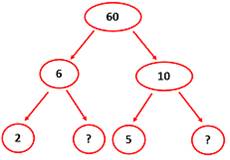
(b)
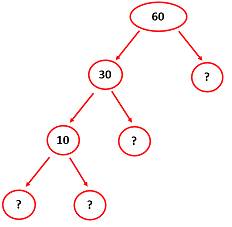
Ans :
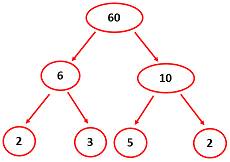
(a) As 6 = 2 × 3 and 10 = 5 × 2
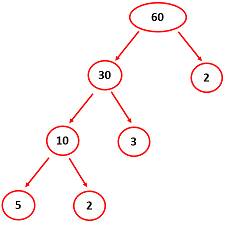
(b) As 60 = 30 × 2, 30 = 10 × 3, and 10
= 5 × 2
Q.3: Which factors are not included in the
prime factorization of a composite number?
Ans :
1 and the number itself
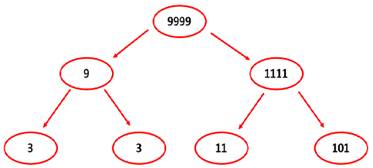
Q.4: Write the greatest 4-digit number and
express it in terms of its prime factors.
Ans :
Greatest four-digit number = 9999
9999 = 3 × 3 × 11 × 101
Q.5: Write the smallest 5-digit number and
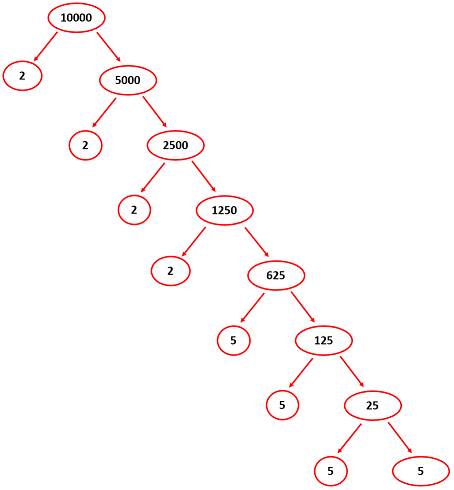
express it in the form of its prime factors.
Ans :
Smallest five-digit number = 10,000
10000 = 2 × 2 × 2 × 2 × 5 × 5 × 5 × 5
Q.6: Find all prime factors of 1729 and
arrange them in ascending order. Now state the relation, if any; between two
consecutive prime factors.
Ans :
|
7 |
1729 |
|
13 |
247 |
|
19 |
19 |
|
1 |
1729 = 7 × 13 × 19
13 − 7 = 6, 19 − 13 = 6
The difference of two consecutive prime
factors is 6.
Q.7: The product of three consecutive
numbers is always divisible by 6. Verify this statement with the help of some
examples.
Ans :
2 × 3 × 4 = 24, which is divisible by 6
9 × 10 × 11 = 990, which is divisible
by 6
20 × 21 × 22 = 9240, which is divisible
by 6
Q.8: The sum of two consecutive odd numbers
is divisible by 4. Verify this statement with the help of some examples.
Ans :
3 + 5 = 8, which is divisible by 4
15 + 17 = 32, which is divisible by 4
19 + 21 = 40, which is divisible by 4
Q.9: In which of the following expressions,
prime factorization has been done?
(a) 24 = 2 × 3 × 4
(b) 56 = 7 × 2 × 2 × 2
(c) 70 = 2 × 5 × 7
(d) 54 = 2 × 3 × 9
Ans :
(a) 24 = 2 × 3 × 4
Since 4 is composite, prime factorisation has not
been done.
(b) 56 = 7 × 2 × 2 × 2
Since all the factors are prime, prime factorisation
has been done.
(c) 70 = 2 × 5 × 7
Since all the factors are prime, prime
factorisation has been done.
(d) 54 = 2 × 3 × 9
Since 9 is composite, prime factorisation has not
been done.
Q.10: Determine if 25110 is divisible by 45.
[Hint: 5 and 9 are co-prime numbers.
Test the divisibility of the number by 5 and 9].
Ans :
45 = 5 × 9
Factors of 5 = 1, 5
Factors of 9 = 1, 3, 9
Therefore, 5 and 9 are co-prime
numbers.
Since the last digit of 25110 is 0, it
is divisible by 5.
Sum of the digits of 25110 = 2 + 5 + 1
+ 1 + 0 = 9
As the sum of the digits of 25110 is
divisible by 9, therefore, 25110 is divisible by 9.
Since the number is divisible by 5 and
9 both, it is divisible by 45.
Q.11: 18 is divisible by both 2 and 3. It is
also divisible by 2 × 3 = 6. Similarly, a number is divisible by both 4 and 6.
Can we say that the number must also be divisible by 4 × 6 = 24? If not, give
an example to justify our answer.
Ans :
No. It is not necessary because 12 and
36 are divisible by 4 and 6 both, but are not divisible by 24.
Q.12: I am the smallest number, having four
different prime factors. Can you find me?
Ans :
Since it is the smallest number of such
type, it will be the product of 4 smallest prime numbers.
2 × 3 × 5 × 7 = 210
Exercise 3.6
Q.1: Find the HCF of the following numbers:
(a) 18, 48
(b) 30, 42
(c) 18, 60
(d) 27, 63
(e) 36, 84
(f) 34, 102
(g) 70, 105, 175
(h) 91, 112, 49
(i) 18, 54, 81
(j) 12, 45, 75
Ans :
(a) 18, 48
|
2 |
18 |
|
3 |
9 |
|
3 |
3 |
|
1 |
|
|
|
|
|
2 |
48 |
|
2 |
24 |
|
2 |
12 |
|
2 |
6 |
|
3 |
3 |
|
1 |
|
18 = 2 × 3 × 3
48 = 2 × 2 × 2 × 2 × 3
HCF = 2 × 3 = 6
(b) 30, 42
|
2 |
30 |
|
3 |
15 |
|
5 |
5 |
|
1 |
|
|
|
|
|
2 |
42 |
|
3 |
21 |
|
7 |
7 |
|
1 |
|
30 = 2 × 3 × 5
42 = 2 × 3 × 7
HCF = 2 × 3 = 6
(c) 18, 60
|
2 |
18 |
|
3 |
9 |
|
3 |
3 |
|
1 |
|
|
|
|
|
2 |
60 |
|
2 |
30 |
|
3 |
15 |
|
5 |
5 |
|
1 |
|
18 = 2 × 3 × 3
60 = 2 × 2 × 3 × 5
HCF = 2 × 3 = 6
(d) 27, 63
|
3 |
27 |
|
3 |
9 |
|
3 |
3 |
|
1 |
|
|
|
|
|
3 |
63 |
|
3 |
21 |
|
7 |
7 |
|
1 |
|
27 = 3 × 3 × 3
63 = 3 × 3 × 7
HCF = 3 × 3 = 9
(e) 36, 84
|
2 |
36 |
|
2 |
18 |
|
3 |
9 |
|
3 |
3 |
|
1 |
|
|
|
|
|
2 |
84 |
|
2 |
42 |
|
3 |
21 |
|
7 |
7 |
|
1 |
|
36 = 2 × 2 × 3 × 3
84 = 2 × 2 × 3 × 7
HCF = 2 × 2 × 3 = 12
(f) 34, 102
|
2 |
34 |
|
17 |
17 |
|
1 |
|
|
|
|
|
2 |
102 |
|
3 |
51 |
|
17 |
17 |
|
1 |
|
34 = 2 × 17
102 = 2 × 3 × 17
HCF = 2 ×17 = 34
(g) 70, 105, 175
|
2 |
70 |
|
5 |
35 |
|
7 |
7 |
|
1 |
|
|
|
|
|
3 |
105 |
|
5 |
35 |
|
7 |
7 |
|
1 |
|
|
|
|
|
5 |
175 |
|
5 |
35 |
|
7 |
7 |
|
|
1 |
70 = 2 × 5 × 7
105 = 3 × 5 × 7
175 = 5 × 5 × 7
HCF = 5 × 7 = 35
(h) 91, 112, 49
|
7 |
91 |
|
13 |
13 |
|
1 |
|
|
|
|
|
2 |
112 |
|
2 |
56 |
|
2 |
28 |
|
2 |
14 |
|
7 |
7 |
|
1 |
|
|
|
|
|
7 |
49 |
|
7 |
7 |
|
|
1 |
91 = 7 × 13
112 = 2 × 2 × 2 × 2 × 7
49 = 7 × 7
HCF = 7
(i) 18, 54, 81
|
2 |
18 |
|
3 |
9 |
|
3 |
3 |
|
1 |
|
|
|
|
|
2 |
54 |
|
3 |
27 |
|
3 |
9 |
|
3 |
3 |
|
1 |
|
|
|
|
|
3 |
81 |
|
3 |
27 |
|
3 |
9 |
|
3 |
3 |
|
|
1 |
18 = 2 × 3 × 3
54 = 2 × 3 × 3 × 3
81 = 3 × 3 × 3 × 3
HCF = 3 × 3 = 9
(j) 12, 45, 75
|
2 |
12 |
|
2 |
6 |
|
3 |
3 |
|
1 |
|
|
|
|
|
3 |
45 |
|
3 |
15 |
|
5 |
5 |
|
1 |
|
|
|
|
|
3 |
75 |
|
5 |
25 |
|
5 |
5 |
|
|
1 |
12 = 2 ×2 × 3
45 = 3 × 3 × 5
75 = 3 × 5 × 5
HCF = 3
Q.2: What is the HCF of two consecutive
(a) Numbers? (b) Even numbers? (c) Odd
numbers?
Ans :
(i) 1 e.g., HCF of 2 and 3 is 1.
(ii) 2 e.g., HCF of 2 and 4 is 2.
(iii) 1 e.g., HCF of 3 and 5 is 1.
Q.3: HCF of co-prime numbers 4 and 15 was
found as follows by factorization:
4 = 2 × 2 and 15 = 3 × 5 since there is
no common prime factors, so HCF of 4 and 15 is 0. Is the answer correct? If
not, what is the correct HCF?
Ans :
No. The answer is not correct. 1 is the
correct HCF.
Exercise 3.7
Q.1: Renu
purchases two bags of fertilizer of weight 75 kg and 69 kg. Find the maximum
value of weight which can measure the weight of the fertilizer exact number of
times.
Ans :
Weight of the two bags = 75 kg and 69
kg
Maximum weight = HCF (75, 69)
|
3 |
75 |
|
5 |
25 |
|
5 |
5 |
|
1 |
|
|
|
|
|
3 |
69 |
|
23 |
23 |
|
1 |
|
75 = 3 × 5 × 5
69 = 3 × 23
HCF = 3
Hence, the maximum value of weight,
which can measure the weight of the fertilizer exact number of times, is 3 kg.
Q.2: Three boys step off together from the
same spot. Their steps measure 63 cm, 70 cm and 77 cm respectively. What is the
minimum distance each should cover so that all can cover the distance in
complete steps?
Ans :
Step measure of 1st Boy = 63 cm
Step measure of 2nd Boy = 70 cm
Step measure of 3rd Boy = 77 cm
LCM of 63, 70, 77
|
2 |
63, 70, 77 |
|
3 |
63, 35, 77 |
|
3 |
21, 35, 77 |
|
5 |
7, 35, 77 |
|
7 |
7, 7, 77 |
|
11 |
1, 1, 11 |
|
1, 1, 1 |
LCM = 2 × 3 × 3 × 5 × 7 × 11 = 6930
Hence, the minimum distance each should
cover so that all can cover the distance in complete steps is 6930 cm.
Q.3: The length, breadth and height of a
room are 825 cm, 675 cm and 450 cm respectively. Find the longest tape which
can measure the three dimensions of the room exactly.
Ans :
Length = 825 cm = 3 × 5 × 5 × 11
Breadth = 675 cm = 3 × 3 × 3 × 5 × 5
Height = 450 cm = 2 × 3 × 3 × 5 × 5
Longest tape = HCF of 825, 675, and 450
= 3 × 5 × 5 = 75 cm
Therefore, the longest tape is 75 cm.
Q.4: Determine the smallest 3-digit number
which is exactly divisible by 6, 8 and 12.
Ans :
Smallest number = LCM of 6, 8, 12
|
2 |
6, 8, 12 |
|
2 |
3, 4, 6 |
|
2 |
3, 2, 3 |
|
3 |
3, 1, 3 |
|
1, 1, 1 |
LCM = 2 × 2 × 2 × 3 = 24
We have to find the smallest 3-digit
multiple of 24.
It can be seen that 24 × 4 = 96 and 24
× 5 = 120.
Hence, the smallest 3-digit number
which is exactly divisible by 6, 8, and 12 is 120.
Q.5: Determine the greatest 3-digit number
exactly divisible by 8, 10 and 12.
Ans :
LCM of 8, 10, and 12
|
2 |
8, 10, 12 |
|
2 |
4, 5, 6 |
|
2 |
2, 5, 3 |
|
3 |
1, 5, 3 |
|
5 |
1, 5, 1 |
|
1, 1, 1 |
LCM = 2 × 2 × 2 × 3 × 5 = 120
We have to find the greatest 3-digit multiple of
120.
It can be seen that 120 ×8 = 960 and 120 × 9 =
1080.
Hence, the greatest 3-digit number exactly
divisible by 8, 10, and 12 is 960.
Q.6: The traffic lights at three different
road crossings change after every 48 seconds, 72 seconds and 108 seconds
respectively. If they change simultaneously at 7 a.m., at what time will they
change simultaneously again?
Ans :
Time period after which these lights
will change = LCM of 48, 72, 108
|
2 |
48, 72,
108 |
|
2 |
24, 36, 54 |
|
2 |
12, 18, 27 |
|
2 |
6, 9, 27 |
|
3 |
3, 9, 27 |
|
3 |
1, 3, 9 |
|
3 |
1, 1, 3 |
|
1, 1, 1 |
LCM = 2 × 2 × 2 × 2 × 3 × 3 × 3 = 432
They will change together after every
432 seconds i.e., 7 min 12 seconds.
Hence, they will change simultaneously
at 7:07:12 am.
Q.7: Three tankers contain 403 litres, 434
litres and 465 litres of diesel respectively. Find the maximum capacity of a
container that can measure the diesel of the three containers exact number of
times.
Ans :
Maximum capacity of the required tanker = HCF
of 403, 434, 465
403 = 13 × 31
434 = 2 × 7 × 31
465 = 3 × 5 × 31
HCF = 31
Hence,
a
container of capacity 31 l can measure the diesel of 3
containers exact number of times
Q.8: Find the least number which when
divided by 6, 15 and 18 leave remainder 5 in each case.
Ans :
LCM of 6, 15, 18
|
2 |
6, 15, 18 |
|
3 |
3, 15, 9 |
|
3 |
1, 5, 3 |
|
5 |
1, 5, 1 |
|
1, 1, 1 |
LCM = 2 × 3 × 3 × 5 = 90
Required number = 90 + 5 = 95
Q.9: Find the smallest 4-digit number which
is divisible by 18, 24 and 32.
Ans :
LCM of 18, 24, and 32
|
2 |
18, 24, 32 |
|
2 |
9, 12, 16 |
|
2 |
9, 6, 8 |
|
2 |
9, 3, 4 |
|
2 |
9, 3, 2 |
|
3 |
9, 3, 1 |
|
3 |
3, 1, 1 |
|
1, 1, 1 |
LCM = 2 × 2 × 2 × 2 × 2 × 3 × 3 = 288
We have to find the smallest 4-digit
multiple of 288.
It can be observed that 288 ×3 = 864
and 288 ×4 = 1152.
Therefore, the smallest 4-digit number
which is divisible by 18, 24, and 32 is
1152.
Q.10: Find the LCM of the following numbers:
(a) 9 and 4 (b) 12 and 5
(c) 6 and 5 (d) 15 and 4
Observe a common property in the
obtained LCMs. Is LCM the product of two numbers in each case?
Ans :
(a)
|
2 |
9, 4 |
|
2 |
9, 2 |
|
3 |
9, 1 |
|
3 |
3, 1 |
|
1, 1 |
LCM = 2 × 2 × 3 × 3 = 36
(b)
|
2 |
12, 5 |
|
2 |
6, 5 |
|
3 |
3, 5 |
|
5 |
1, 5 |
|
1, 1 |
LCM = 2 × 2 × 3 × 5 = 60
(c)
|
2 |
6, 5 |
|
3 |
3, 5 |
|
5 |
1, 5 |
|
1, 1 |
LCM = 2 × 3 × 5 = 30
(d)
|
2 |
15, 4 |
|
2 |
15, 2 |
|
3 |
15, 1 |
|
5 |
5, 1 |
|
1, 1 |
LCM = 2 × 2 × 3 × 5 = 60
Yes, it can be observed that in each
case, the LCM of the given numbers is the product of these numbers. When two
numbers are co-prime, their LCM is the product of those numbers. Also, in each
case, LCM is a multiple of 3.
Q.11: Find the LCM of the following numbers
in which one number is the factor of the other.
(a) 5, 20 (b) 6, 18
(c) 12, 48 (d) 9, 45
What do you observe in the results
obtained?
Ans :
(a)
|
2 |
5, 20 |
|
2 |
5, 10 |
|
5 |
5, 5 |
|
1, 1 |
LCM = 2 × 2 × 5 = 20
(b)
|
2 |
6, 18 |
|
3 |
3, 9 |
|
3 |
1, 3 |
|
1, 1 |
LCM = 2 × 3 × 3 = 18
(c)
|
2 |
12, 48 |
|
2 |
6, 24 |
|
2 |
3, 12 |
|
2 |
3, 6 |
|
3 |
3, 3 |
|
1, 1 |
LCM = 2 × 2 × 2 × 2 × 3 = 48
(d)
|
3 |
9, 45 |
|
3 |
3, 15 |
|
5 |
1, 5 |
|
1, 1 |
LCM = 3 × 3 × 5 = 45
We observe that in all of these cases,
the LCM of the given numbers is the larger number.
Hence, when one number is a factor of
the other number, their LCM will be the larger number.
End of Questions